
In many adhesive development programs, early compatibility screening follows a familiar pattern. The adhesive is laminated to a candidate liner, a peel test is run, and the result is judged by whether the release looks manageable and clean. If the force appears acceptable, that liner direction is often treated as a reasonable starting point.
That logic works well enough in many acrylic and rubber-based PSA systems. The adhesive and the release surface are chemically distinct, so the interface usually does not change dramatically during the first stage of contact. A quick peel test can therefore provide useful early guidance.
Silicone PSA systems change that assumption. A silicone PSA and a standard silicone release coating belong to the same chemical family, and that interfacial affinity changes the nature of the interface from the beginning.
The issue is no longer only whether the construction peels today. The more important question is whether that interface will remain stable after contact has had time to develop.
That is where many early screens go wrong. The test appears to answer a practical question: Can this liner work? But what it may actually answer is much narrower: What does the peel force look like at the moment I measured it?
In silicone PSA systems, those are not always the same question.
Early compatibility screening in silicone PSA systems does not simply ask whether the liner peels cleanly today. It asks whether the liner-adhesive interface is directionally stable enough to justify deeper development work.
Why T-Zero Results Can Mislead in Silicone PSA Screening
The main problem with T-zero testing is not that the number is inaccurate. The problem is that the timing is incomplete.
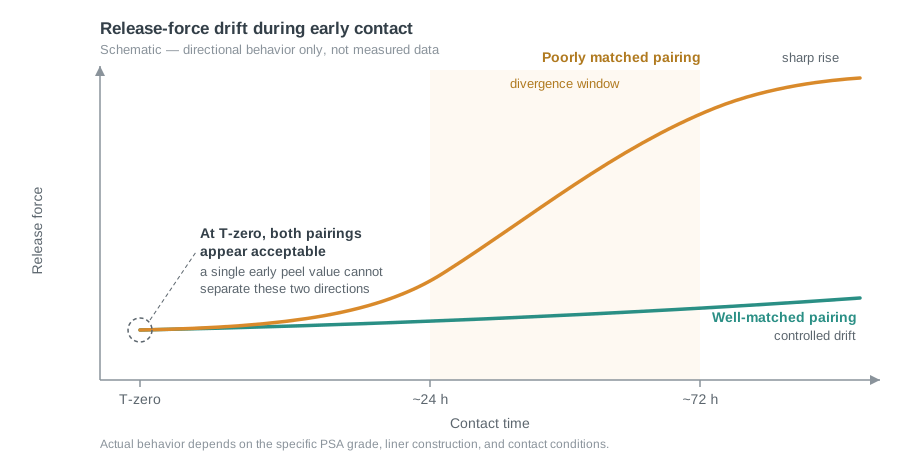
When peel is measured immediately after lamination, the interface has had very little time to evolve. A standard silicone-coated liner may still appear perfectly acceptable against a silicone PSA in that fresh state. Release may feel smooth, the force may fall within an expected range, and nothing may yet suggest that the pairing is moving in the wrong direction.
The real risk often appears later.
As dwell time increases, interfacial affinity begins to show more clearly. Two chemically related materials do not always maintain a clean and stable boundary in the same way two clearly different materials do. The interface can continue to shift during contact, and release force can move with it.
In a well-matched system, that change may remain controlled. In a poorly matched system, release force may rise sharply during the first 24 to 72 hours. In more severe cases, the problem is not simply heavier peel. It can progress into adhesive rupture, liner or carrier damage, or a construction that is no longer practical to process.
T-zero does not warn you about that, because T-zero is not the stage at which incompatibility fully reveals itself.
That is why familiar quick-screen habits are especially risky in silicone PSA programs. The test may have measured the force correctly, but it measured the wrong question. It recorded the interface at formation — not the direction that interface was moving toward.
Why Some Early Failures Do Not First Appear as Release Drift
For engineers working with platinum-catalyzed, addition-cure silicone PSA systems, there is a second early-screening risk that has no close equivalent in most acrylic PSA work.
Platinum-cure silicone systems can be sensitive to certain substances present at the contact surface. When those substances interfere with the platinum catalyst, cure behavior near the interface can be disrupted. The result is not always an obvious global cure failure. More often, the problem appears as localized under-cure at or near the surface — with abnormal surface properties, softness, or tack behavior — even when the bulk adhesive still appears largely normal.
A peel-force number alone may not detect that structure clearly.
A liner that creates platinum-cure inhibition may still produce an apparently acceptable Day-0 peel result, because the measurement reflects average release behavior rather than local surface chemistry. The consequences often appear later: insufficient bond development on sensitive substrates, failure to meet cleanliness or surface-performance requirements, or unstable results after aging or deeper validation.
That changes the logic of early screening in an important way.
If the cure mechanism of the silicone PSA has not been identified, the screen may be looking for the wrong failure mode from the start.
For platinum-cure silicone PSA systems, cure mechanism is therefore not background information to confirm later. It is a required input before early screening begins. How cure conditions shape the starting liner direction more broadly is a separate selection question.
Two Questions That Have Long Been Treated as One
Early silicone PSA screening often fails not because teams test too little, but because two different questions get collapsed into one.
The first question is straightforward: what is the peel force of this pairing, and does it fall within the intended operating range?
The second question is different: will this interface remain stable after contact time accumulates, and will the release relationship stay usable under dwell, storage, and real process conditions?
In many acrylic PSA systems, those two questions tend to move together. Early peel results often provide at least some directional indication of longer-term behavior because the interface does not change rapidly during early contact.
In silicone PSA systems, they can separate quickly.
A pairing may look completely acceptable at T-zero and behave very differently after 48 or 72 hours. A liner that creates cure inhibition may even continue to return normal-looking peel values while the interface chemistry has already been compromised.
Once those two questions are treated as if they were the same, a screen designed only to answer the first one will be misread as if it also answered the second. That is one of the most common sources of false confidence in early silicone PSA work.
What is the peel force now?
Will this interface remain stable after dwell, storage, and process exposure?
What a Meaningful Early Screen Should Establish
Early compatibility screening is a selection-stage filter, not a validation protocol. Its purpose is not to prove everything. Its purpose is to determine whether a liner direction is credible enough to carry into the next stage of development.
- Adhesive family:verify that the system is silicone PSA, not acrylic or rubber-based
- Cure mechanism:platinum-catalyzed addition cure and peroxide cure do not create the same early-screening risks — this must be confirmed before the candidate list is assembled
- Expected contact period:how long the adhesive will remain against the liner during storage or process staging
- Exposure boundary:whether heat, pressure, compression, or extended dwell will intensify interfacial change
- Application sensitivity:how little tolerance the program has for silicone transfer, surface disruption, or bond instability
These are not test parameters. They are the minimum context needed to decide which liner directions deserve to enter the screen in the first place. Without that context, a single peel-force value is easy to overread.
Once screening begins, two signals matter most:
Whether the interface drifts modestly or rises sharply over the first contact period is the primary compatibility signal. Without this contrast, the screen has only recorded the interface at formation — not whether it is stable.
Normal peel force does not confirm that the adhesive face is unaffected. After removal, check whether the adhesive maintains expected tack and bonding performance — particularly in platinum-cure systems where surface-level disruption may not appear in the peel measurement at all. A structured approach to adhesive integrity evaluation belongs in validation. When multi-variable performance interpretation is needed, that work also belongs outside the screening stage.
Why Fluorosilicone Does Not Remove the Need for Early Screening
In many silicone PSA programs, fluorosilicone is the more defensible starting coating direction — and specifying it is often the right call. But it does not eliminate the need for early screening.
Different fluorosilicone constructions do not behave identically, and compatibility still depends on the specific PSA grade, contact history, and application boundary. Moving to a fluorosilicone liner narrows the chemistry direction. It does not complete the compatibility decision.
Whatever coating direction is chosen, the core screening question does not change. The specific liner-adhesive pairing still needs to remain stable over a meaningful contact period.
Coating-direction logic is a separate question.