
The liner removed cleanly. That still does not tell you whether the adhesive surface is ready for what comes next.
A clean release event tells you something important. It tells you the separation itself looked acceptable under the conditions used. But it does not automatically tell you whether the adhesive face is still in the right condition for the next step. That question needs its own inspection logic.
In silicone PSA systems, that distinction matters more than many teams expect. A fluorosilicone release coating and a silicone PSA interact more closely than a silicone coating and an acrylic adhesive. That means surface-level change can occur during contact without becoming visible at the moment of peel. The liner may still release cleanly. The adhesive surface may still look intact. But the downstream bonding step may not see the same result.
A passing release check, in this context, is a necessary condition. It is not a sufficient one.
The multi-variable check framework established that peel force, behavior quality, and adhesive-side outcome are structurally independent observables — each requiring its own evidence. This article addresses the third of those: what it means to inspect the adhesive-side condition, how the required inspection scope is determined, and why the moment of peel is not always the right reference point for that inspection.
This article focuses on the logic of inspection scope — what to look for and at what level, depending on the application. It does not define test methods or protocols, interpret abnormal results, or address documentation requirements for formal qualification programs.
What a Clean Peel Does and Does Not Confirm
When a liner removes cleanly from a silicone PSA laminate, two things are confirmed. The separation occurred without cohesive failure in the adhesive. The peel force was within range. These are meaningful results. They answer the question the release event is designed to answer: did the liner release as expected?
The question that remains open is different: is the adhesive face in the condition the downstream application requires?
In acrylic PSA systems, a clean peel is often a reasonable proxy for acceptable surface condition. In silicone PSA systems, that proxy is less reliable. The interfacial chemistry is more active, and the result is not always visible. The adhesive surface can look intact and behave acceptably during liner removal while still carrying a condition that reduces tack, disrupts downstream bonding, or creates inconsistency in later process steps.
A program that records only the release event leaves the adhesive-side condition open.
A clean peel confirms the release event — not the adhesive surface condition.
In silicone PSA systems, these are answers to two different questions. A program that records only the release event leaves the adhesive-side condition open.
What “Adhesive Integrity” Means in Operational Terms
The phrase appears in specifications, quality procedures, and supplier communications without a consistent operational definition. One team uses it to mean “no visible residue.” Another uses it to mean “still bonds correctly in the next step.” A third uses it to mean “no meaningful surface change, even below visual threshold.” The validation record then uses one phrase to cover different standards of evidence.
That inconsistency is worth resolving before discussing how to assess the condition. For the purposes of this article, adhesive integrity after liner removal refers to three distinguishable dimensions:
Surface cleanliness — the adhesive face is free of contamination above the threshold the downstream application tolerates. In low-sensitivity applications, this means no gross residue. In higher-sensitivity applications, it means no meaningful surface condition change during liner contact, including changes that are not visible but that affect surface energy, wetting behavior, or tack.
Functional adhesion retention — the adhesive performs as expected in its downstream bonding step. Bond strength, initial tack, and sustained adhesion are within the range the application requires after a representative dwell and exposure history. This is a performance statement, not an appearance statement.
Structural continuity — the adhesive face is intact. No delamination, no micro-defects, and no weak zones at the surface that would reduce effective contact area at the next bonding step.
Four observable categories map to these dimensions:
- Visible residue — gross contamination, obvious liner material on the adhesive face, or transfer visible under normal or raking-angle illumination.
- Surface energy shift — a change in the wetting behavior of the adhesive face indicating that the surface condition has changed below the visual threshold.
- Bondability — whether the adhesive achieves expected bond strength and retention in the downstream application.
- Downstream functional performance — whether the adhesive performs as needed through the full service condition, including any exposure, temperature cycling, or process step that follows bonding.
Not every program needs to confirm all four. Which ones matter is determined by the application.
Inspection Scope Is an Application-Driven Decision
The most consequential mistake in adhesive-side inspection is applying a fixed-output approach regardless of application sensitivity. Visual inspection as the universal default is adequate in some programs. In others, it leaves the most meaningful question — is the adhesive surface actually ready? — unanswered.
Inspection scope should be determined by what the downstream function requires, not by what is most convenient to perform or most common in a given industry segment.
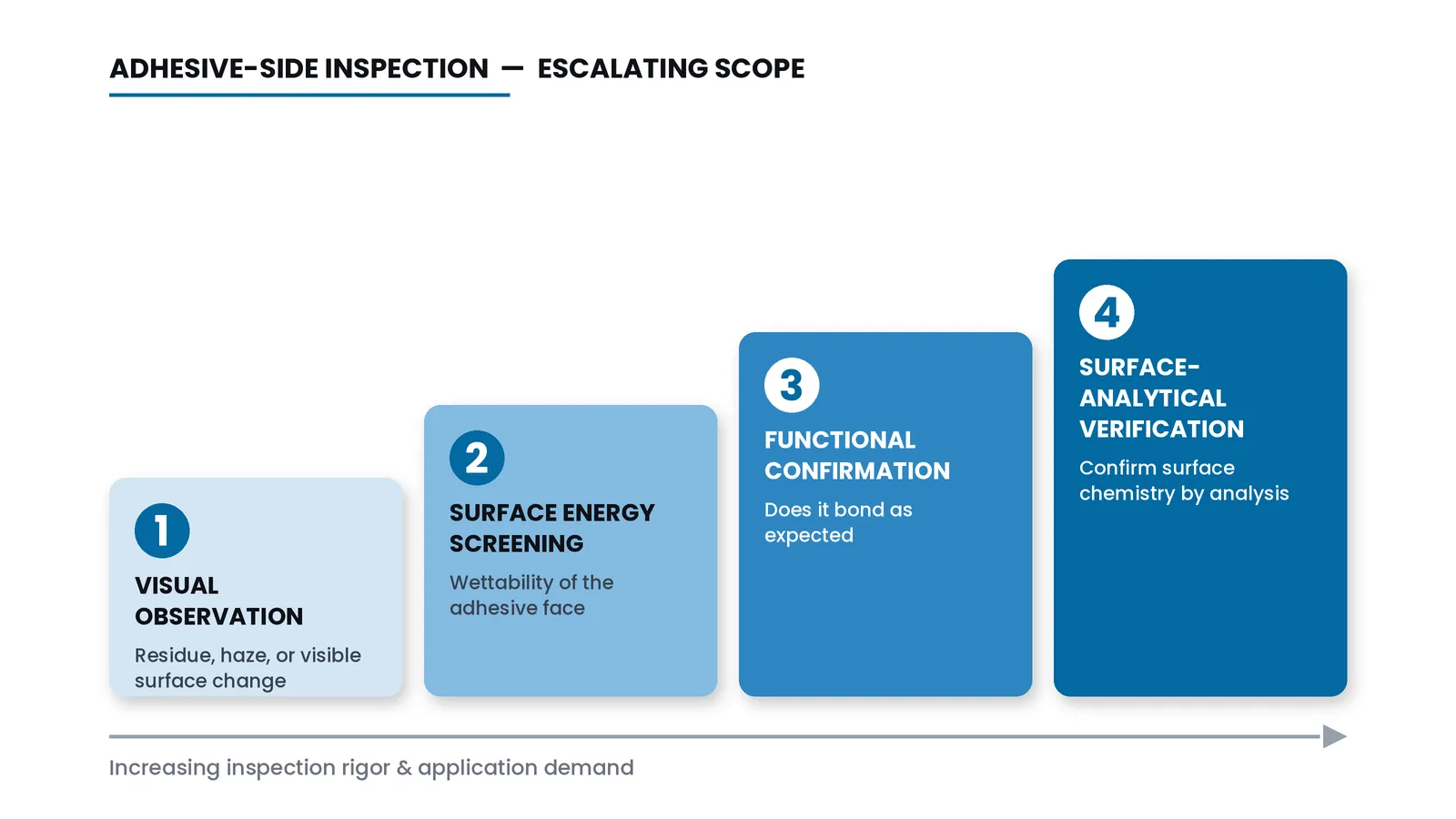
A practical way to reason about inspection scope is through detection levels. Four levels describe the main inspection approaches, each answering a different question about adhesive surface condition.
Visual observation
Visual observation confirms whether there is gross contamination — residue, transfer, delamination, or obvious surface disruption — detectable under normal or directed illumination. It answers the question: is there a visible problem? It does not answer whether a sub-visible condition change has occurred, whether surface energy has shifted, or whether downstream bonding will perform as expected.
For applications where the downstream function is tolerant of surface-level variability — general industrial converting, many label applications — visual observation is a proportionate inspection level. For applications where the downstream function is sensitive to surface-level variability — medical contact adhesives, optically clear laminates, precision electronics bonding — visual observation alone is structurally insufficient.
Surface energy screening
Surface energy screening — through contact angle measurement or equivalent surface wetting indicators — adds an intermediate detection layer between visual observation and full surface analysis. A surface energy shift is a signal that the adhesive face condition has changed in a way that may affect downstream bonding, even when nothing is visually visible. It does not identify the source of the shift or confirm the downstream consequence, but it provides a meaningful screening signal at a lower complexity level than full surface analysis.
This intermediate level is particularly useful in programs where visual inspection is known to be insufficient but where the program does not yet have evidence of a specific contamination risk. A result consistent with the expected baseline provides more information than visual alone. A result that deviates from the baseline is a signal worth investigating before the program moves to a downstream bonding commitment.
Functional confirmation
Functional confirmation is the most important escalation step for many real programs. Here the question is not whether the surface looks acceptable, but whether it still performs as required in the next relevant use condition. A visually clean adhesive face may still fail the application’s actual requirement. A functional confirmation step tests whether that happened.
This is the level that directly answers the question the program is ultimately asking: does this adhesive, after this liner removal history, perform the downstream bonding job it is required to perform?
Surface-analytical verification
Surface-analytical verification is relevant when the program needs to answer a finer surface-condition question than visual or functional observation alone can resolve — for instance, confirming the absence or presence of a specific migrated species at the adhesive face. It is not justified as a universal default, and the choice of method is application- and program-specific.
This level becomes meaningful when the application’s tolerance is tight enough that sub-visible surface change matters, or when the program needs a clearer answer about whether the surface condition itself has shifted in a way that lower-level checks cannot resolve directly.
These levels are not a prescribed sequence. A program may begin at functional confirmation if the application sensitivity and available resources make that the most direct path. A program may use surface energy screening as a periodic check after visual inspection has been established as the baseline. The goal is to match the detection level to the question the application actually requires answering.
The correct inspection level is determined by what the downstream application requires — not by convention.
Visual observation is proportionate for some programs and structurally insufficient for others. The goal is to match detection level to the question the application actually needs answered.
When You Inspect Matters, Not Just What You Inspect
Most inspection protocols define what to look for. Fewer define when the inspection should take place relative to the downstream bonding step — and that timing decision can affect what the inspection result actually means.
The broader argument that initial data alone does not confirm long-term stability is already established in the Performance Validation pathway. The narrower point here is more specific: the adhesive-side inspection moment should be chosen based on when the result must still be valid, not only on when the liner happened to be removed.
Inspection at the moment of liner removal captures the adhesive surface condition at one specific point in time. For many programs, this is the right reference point — particularly when the downstream bonding step follows immediately and the adhesive will not be exposed to additional dwell, temperature, or handling before use.
The timing question becomes more significant when there is a gap between liner removal and downstream bonding. Adhesive surfaces are not necessarily static after liner removal. In silicone PSA systems where surface effects from liner contact are present near the detection boundary, those effects may continue to develop or become more apparent after separation. A surface that appears acceptable immediately after liner removal may not produce the same functional bonding result an hour or a day later, depending on the adhesive, the exposure conditions, and the sensitivity of the downstream use.
This is not an argument that all programs need time-staged inspection. It is an argument that inspection timing should be a deliberate decision. The practical question is not “when do we usually inspect?” It is “at what point does this adhesive surface need to still be acceptable for the actual application?”
No universal inspection timing exists. The application’s own process logic defines the relevant window.
Giving the Adhesive-Side Check a Defined Acceptance Criterion
Most validation programs define acceptance criteria for peel force with reasonable precision: a target band, a lot acceptance boundary, a comparison window against a reference. The adhesive-side check in the same program is often recorded as a qualitative observation — “appearance acceptable,” “no visible residue,” “surface intact.” There is no defined criterion, no threshold, and no equivalent decision gate.
That structure is weak. If the adhesive-side condition matters to the program, then it needs its own decision gate. Otherwise the more important question may be documented with the least disciplined evidence.
An acceptance gate does not mean a universal numeric rule. The gate should remain application-defined. But the principle is still important: if adhesive-side condition is part of what the application needs, then the validation plan should state what counts as acceptable, at what inspection level, and at what timing reference. That statement can be qualitative where qualitative is appropriate, or functional where functional is appropriate. The specifics belong to the application.
This discipline also matters across parties. A liner supplier, a converter, and an OEM may each believe they have “checked the adhesive side,” while actually working at different inspection levels. One may have performed a visual check. Another may care about representative downstream function. A third may require higher-confidence surface verification. Without a stated acceptance discipline, those differences stay hidden until discrepant results appear. Aligning on what each party is inspecting, at what detection level, and at what point in the process is the simplest way to make the results interpretable in the same frame.
What This Inspection Should Decide
Adhesive-side inspection should decide whether the exposed adhesive face remains suitable for the next downstream step after liner removal.
If the inspection remains clean at the level the application requires, the release event and adhesive-side condition can be treated as separate but compatible validation observations.
If the inspection shows residue, surface change, adhesion loss, or inconsistent downstream performance, the question has moved beyond inspection scope. At that point, the result needs diagnosis, broader validation evidence, or qualification review depending on the pattern. Where the symptom is residue-like, that diagnosis starts from silicone transfer residue triage.
Not automatically. A clean release confirms the separation occurred at acceptable force without visible disruption. It does not confirm the condition of the adhesive face after separation — particularly in silicone PSA systems where interfacial chemistry can produce sub-visible surface changes that affect downstream bonding without disturbing the peel event itself.
The required inspection depth depends on what the downstream application tolerates. Visual observation is sufficient when the application has low sensitivity to surface-level variability. Programs with higher downstream sensitivity — medical contact, optical lamination, precision electronics bonding — typically require functional confirmation that the adhesive still performs as expected, and in some cases surface-analytical verification. There is no universal inspection protocol; the scope is determined by the application’s own requirements.