
Two engineers on the same project, looking at the same data, reach different conclusions about whether the liner is ready.
One says: the force is in range, the samples behaved acceptably during the trial run, nothing transferred visibly. Three checks, all acceptable. Validation is done.
The other is not satisfied. She cannot point to a specific failure. But she is not confident the checks were structured to answer the combined performance question.
The disagreement is not about the numbers. It is about whether three individually acceptable results add up to a jointly acceptable validation judgment. That is the problem the multi-variable check is designed to resolve.
Why the Three Variables Must Be Read as a Set
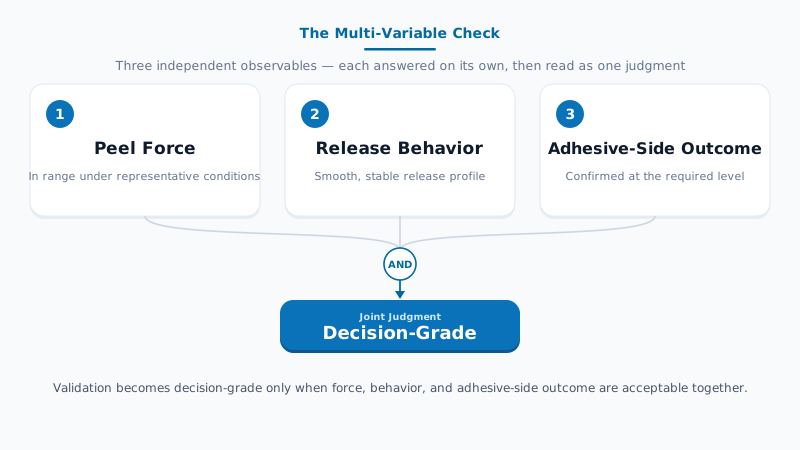
Peel force magnitude, peel behavior quality, and transfer or adhesive-side outcome are not three expressions of the same variable. They measure different aspects of the liner-adhesive interface at different points in the process sequence. They can move independently. A result that is acceptable on one dimension does not predict the others.
This independence is not a theoretical concern. It is the structural reason that force-only validation — as explained in beyond the peel force — can produce a passing result while a process or downstream problem remains undetected.
Peel force, behavior quality, and transfer or adhesive-side outcome are structurally independent observables. They can move in different directions. An acceptable result on one dimension does not predict the others.
Three individually acceptable results do not automatically equal a jointly acceptable validation judgment.
What peel force records — and what it leaves open
A peel force measurement records the energy required to separate the liner from the adhesive under specific test conditions. It confirms that the liner releases within the target window under those conditions. It does not confirm the state of the adhesive surface after separation is complete. It does not confirm whether the release was mechanically smooth. It does not confirm whether the interface left anything behind.
The force result answers one question. That question is narrower than most validation frameworks assume.
What behavior quality adds
Two liners can produce identical average peel force values and behave very differently in a converting operation. One releases with a stable, continuous peel front. The other releases with intermittent hesitation — brief load spikes before the separation resumes. Both show the same average. The distribution is different.
That difference matters. A peel line experiences the release event point by point across the web, not as an average. Micro-instability at the peel front creates variation in web tension. In tight-geometry die-cut applications it can contribute to part lifting. In matrix removal it amplifies stress variation at speed. None of this is captured by the force number.
A liner’s average peel force and its peel behavior quality are not the same variable.
Two liners can share identical average force values and produce very different release profiles in converting. The average does not describe the peel event. Behavior quality must be observed directly.
Why transfer and adhesive-side outcome is a separate observable
The force measurement is complete when the liner separates from the adhesive. What happens to the adhesive surface after that — whether it remains functionally intact, whether the interface left anything behind — is a question the force result never addressed.
In silicone PSA systems, this distinction matters more than in acrylic systems. Standard silicone release coating and silicone PSA share the same polymer backbone. That chemical proximity creates an interfacial affinity that, under the right conditions, can result in low-molecular-weight silicone species migrating from the coating into the adhesive layer. The migration occurs below the visible surface. A clean-looking peel does not rule it out.
The practical consequence depends entirely on what the adhesive must do next. In a general industrial application the effect may be negligible. In a medical wearable, an optically clear adhesive construction, or a precision bonding application, a surface condition that appears clean by visual inspection may already be outside the functional tolerance for downstream bonding. This is why transfer and adhesive-side outcome must be treated as a separately scored dimension — not as a byproduct of the force result, and not as something to check only after a visible concern has appeared.
What Each Variable Requires as a Minimum-Sufficient Observable
Application requirements determine what is acceptable; no universal thresholds apply. What can be defined is the kind of observation that gives each variable a meaningful answer.
Peel force is meaningful when taken under conditions that represent the actual application boundary — the relevant dwell history, the adhesive system being qualified, a test geometry that reflects real removal conditions. A force result taken against a generic reference tape under narrow conditions answers whether the liner met a specification under those conditions. It does not confirm usable behavior in the real process. Positional consistency across the roll width, and lot-to-lot stability, are part of what a decision-grade force result should cover.
Behavior quality requires direct observation of the peel event under representative process conditions — realistic removal speed and angle. The signals to observe are: intermittent hesitation or micro-jumping at the peel front, tactile or audible irregularity during release, non-uniform peel-front progression across the web. Smooth, continuous release across the peel front is the target state. These signals are qualitatively observable without specialized instrumentation, though tighter-tolerance converting environments may warrant more systematic characterization. A mean value that falls within the target window cannot substitute for this observation.
Transfer and adhesive-side outcome requires a detection level matched to what the application’s downstream function demands. At lower sensitivity, visual inspection after peel provides a basic check for gross contamination. Where downstream function is more demanding — medical contact, optical lamination, precision bonding — functional confirmation is needed: does the adhesive still perform as expected after a representative dwell and exposure history? In programs where even sub-visible contamination is a concern, surface-analytical methods can confirm what functional testing cannot resolve. The choice of detection level belongs to the application’s sensitivity requirements, not to a universal protocol.
What “Balancing” Actually Means
Balancing does not mean optimizing all three variables simultaneously to their best possible state. In practice, many liner systems involve trade-offs. A coating direction chosen for very light release may require more thorough confirmation of adhesive-side integrity. A liner selected for behavior smoothness may need validation across a wider condition range to confirm the same surface outcome. These are not disqualifying — they are engineering realities the check set is designed to surface.
Balancing means understanding the relationships between the three observables for the specific application, and confirming that the combination is jointly acceptable — not that each variable individually cleared a threshold.
Balancing does not mean finding a liner that scores perfectly on all three variables.
It means confirming that the combination of force, behavior, and adhesive-side outcome is jointly acceptable for the specific application — and understanding which trade-offs are tolerable and which are not.
When variables point in the same direction
Force is within the usable window, behavior is smooth and stable under representative process conditions, and adhesive-side outcome confirms functional integrity after liner removal. That combination, documented under conditions that represent the application, is a decision-grade result. It answers not just “did each check pass?” but “does the system perform as needed across the relevant dimensions?”
When variables point in different directions
An in-range force result with inconsistent behavior quality is not a clean pass. It indicates the liner releases at the right magnitude but that the mechanical character of the release is not confirmed as process-stable. The force result is not wrong. The behavior check needs more work.
A smooth, force-acceptable release with unresolved adhesive-side integrity is also not a clean pass in applications where that integrity matters. The separation event looks acceptable. The post-separation surface condition is still open.
A combination where force and behavior are both acceptable but transfer risk has not been assessed to the level the application requires is an incomplete check set.
In each case, the correct response is not to weight the passing variables against the open one. It is to recognize which variable has not been answered at the needed level, and to design that specific confirmation before the combined result is used to support a decision.
Where This Check Ends and Other Work Begins
The multi-variable check is a validation-layer tool. It defines what must be observed and how to interpret the combined result. It is not a starting-direction selector and it is not a failure diagnosis framework.
If the check reveals that one or more variables falls outside the acceptable range, understanding why — symptom-by-symptom investigation — belongs to a different kind of analysis. If the combined result raises a question about whether the liner direction itself needs to be reconsidered, that belongs to Material Selection as a prior-stage question.
How to sequence this check across time — relative to initial screening, extended dwell, and aging exposure — is a separate layer of validation plan design this article does not attempt to cover.
The three-variable check described here is a minimum-sufficient framework for most silicone PSA liner validation contexts. It does not replace a full performance validation plan. It defines what must be read together before a validation judgment can be called decision-grade.