
The Decision Is About Match, Not About Tier
In many silicone PSA development discussions, fluorosilicone release coating appears as the default starting point. It shows up in specification sheets, supplier recommendations, and engineering shorthand — “we use an FSi liner” — and the discussion often stops there.
That is not inherently wrong. In many applications, fluorosilicone is functionally the more appropriate direction.
The problem is that the reasoning is often left unstated.
Whether fluorosilicone is actually necessary depends on the application conditions and the adhesive system, not on fluorosilicone being a generally “better” coating. Treating fluorosilicone as a universally superior default is a quality-hierarchy frame. The real logic of coating chemistry selection is a system-match question.
Standard silicone and fluorosilicone (FSi) release coatings are different coating families — not quality tiers of the same product. The real selection question is whether the adhesive system and application conditions have crossed into a boundary where coating chemistry itself becomes a real engineering variable.
What Silicone vs. Fluorosilicone Actually Changes at the Interface
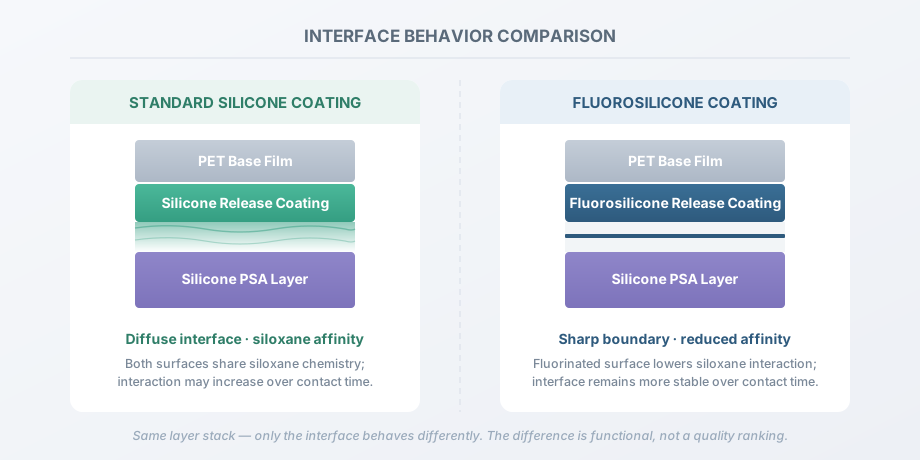
One of the most important differences between standard silicone release coating and fluorosilicone release coating appears at the interface between the release surface and a silicone-based adhesive.
Silicone PSA contains a siloxane backbone. When it contacts a standard silicone release surface, the two sides often show a stronger tendency toward interfacial affinity because both are siloxane-based systems. In short-duration, lower-severity applications, that tendency may remain manageable. Peel performance can look normal, and Day-0 release-force values may appear fully acceptable.
Under more demanding conditions, however, that same interfacial tendency can become more meaningful. As dwell time increases, aging occurs, or contact pressure and exposure severity rise, the interface may become less neutral. Release-force drift, interfacial transfer risk, or reduced long-term predictability can become more relevant.
The value of fluorosilicone is not that it sounds more advanced. Its value is that, in certain silicone adhesive systems and under more demanding conditions, it may alter that interfacial logic enough to become a more defensible starting direction. At that point, coating chemistry is no longer just a background condition. It becomes a real engineering variable that affects whether the liner-adhesive relationship is likely to remain usable.
One important caveat remains: under mild conditions, this difference may not appear clearly at all. Day-0 peel results from the two coating families can look very similar, making it easy to conclude that the distinction does not matter. The real difference often emerges only when the contact history becomes longer or the application becomes more severe.
Two Common Selection Errors
When teams decide between standard silicone and fluorosilicone, the most common mistakes usually appear in opposite directions. The real question is not which coating sounds more advanced. It is which error is more likely in this system.
Some teams see silicone PSA and immediately treat fluorosilicone as the safer, higher-spec default. If the application has not actually crossed into a region that requires fluorosilicone, moving there too early often adds cost, reduces sourcing flexibility, and makes the program appear more resolved than it really is.
The opposite mistake is to treat standard silicone as the neutral baseline until it clearly fails. In some adhesive systems and application conditions, mismatch risk is visible much earlier. Continuing to treat standard silicone as the default may simply delay the more defensible direction.
When Fluorosilicone Becomes Easier to Justify
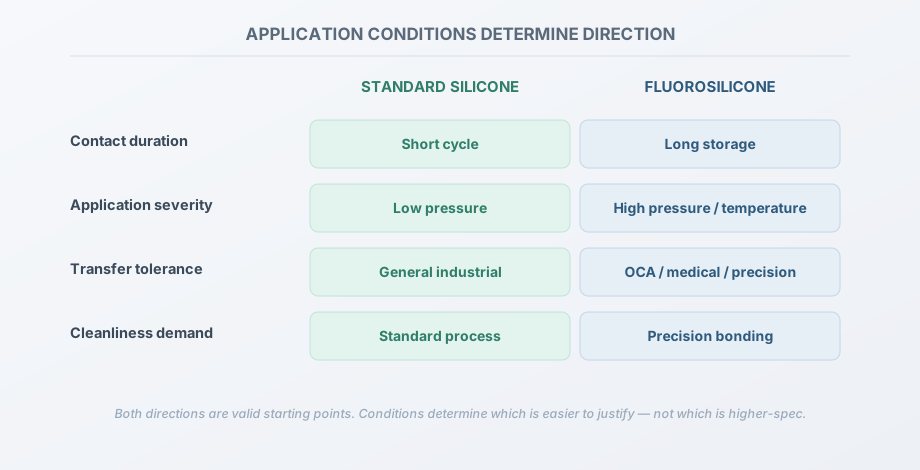
The following conditions often make fluorosilicone easier to justify as the starting direction. This does not mean that any one condition automatically requires fluorosilicone. More precisely, it means that under these conditions, coating chemistry starts to behave less like a background detail and more like a real selection variable.
Higher application severity
Longer storage life, sustained high-pressure lamination, elevated temperature exposure, or other conditions that increase the burden on interfacial stability all give long-term release behavior more decision weight than a Day-0 peel number. In these situations, fluorosilicone often becomes easier to defend as the starting direction. Where high-temperature curing is part of the process, cure conditions can also shape the starting liner direction before sampling begins.
Lower tolerance for interfacial transfer or residue
Applications such as OCA, medical direct-contact systems, or certain semiconductor process-support uses often have little tolerance for interfacial transfer, surface residue, or contamination risk. Where that tolerance is unusually low, fluorosilicone usually becomes easier to justify earlier in selection. When silicone transfer risk is the more specific downstream concern, that question has its own selection logic.
Adhesive systems that are more likely to amplify interfacial interaction
Some adhesive systems — for example, those with higher viscosity, higher coat weight, or more interaction-sensitive behavior after extended contact — are more likely to expose the limits of a standard silicone release surface over time. That does not mean fluorosilicone is automatically required, but it does mean that coating family deserves earlier attention in the selection logic.
Downstream processes with very high cleanliness demands
If downstream steps involve optical function, lamination quality, recoating, precision bonding, or other surface-sensitive requirements, behavior that may be acceptable in a general industrial context may no longer be acceptable here. In these cases, fluorosilicone often becomes easier to justify as the starting direction.
When Standard Silicone Still Makes Sense as the Starting Direction
Setting fluorosilicone as the default answer for every silicone PSA application is not precise selection. It is a shortcut around the actual question.
In the following situations, standard silicone release coating often still has a reasonable technical basis as the starting direction.
Lower-severity applications with shorter contact history
Fast-cycle converting, brief contact duration, and rapid removal sequences usually place much less weight on long-term interfacial stability. In these situations, differences that only become more relevant after extended contact may never develop into the main selection issue.
Existing history already supports standard silicone
If test history, supplier knowledge, or prior program experience already shows that a given adhesive system remains acceptably stable on a standard silicone release surface, there is no strong reason to switch simply because fluorosilicone appears higher-spec. That move may add cost and constraint without adding corresponding functional value.
Application contexts with more general process tolerance
Where the application is not optical, not medical direct-contact, and not especially cleanliness-sensitive, the system often has more process margin and tolerance. In those contexts, standard silicone should not be treated as automatically inadequate.
The team is still at the screening stage
If the current goal is to narrow the starting direction and arrange sample testing rather than lock the final specification, standard silicone can still serve as a useful baseline for comparison, especially where cost, availability, or supply-chain conditions are also real constraints.
The Hidden Cost of Defaulting to Fluorosilicone
Of the two common selection errors above, over-specifying with fluorosilicone is often the less visible one. That is why its downstream cost deserves separate attention.
When fluorosilicone is set as the default without a clearly defined functional reason, the consequence is not just a cost difference.
First, it can add constraint without adding matching functional value. If the application does not actually require the boundary that fluorosilicone provides, moving to fluorosilicone may force unnecessary recalibration of the initial release target and create adjustment cycles that were never needed.
Second, switching coating family may improve the observed result without clearly explaining which system variable was actually limiting the prior behavior. A coating chemistry upgrade may help, but it does not automatically mean the team has identified the real reason the previous direction was becoming unstable.
Third, it leaves future projects with a specification history but no boundary explanation. When engineers inherit “we used FSi before” without understanding why it was necessary, the same imprecise logic tends to be repeated in the next development cycle.
Questions to Answer Before Choosing Silicone or Fluorosilicone
Before formal sampling begins, the following questions usually help confirm whether the team is truly facing a fluorosilicone-versus-silicone chemistry-choice question.
-
What is the adhesive system?
The adhesive system is always the first input to coating selection. If the adhesive itself is still not clearly defined, it is too early to treat fluorosilicone as the conclusion.
-
What is the actual storage life and contact duration?
If storage is measured in weeks and the contact history is short, the relevance of long-term interfacial behavior is lower. If contact duration is measured in months, the coating-chemistry boundary usually deserves earlier attention.
-
How low is the downstream tolerance for residue or interfacial transfer?
If downstream steps involve optical function, medical direct contact, precision bonding, or other high-cleanliness demands, that tolerance should be an input to coating chemistry selection from the beginning, not something discovered only after problems appear.
-
Is the team narrowing a starting direction or locking a final specification?
If the work is still at the screening stage, the goal should be to define a defensible starting direction, not to freeze the final specification too early. Those are not the same decision.
These questions cannot replace formal system-level validation. But they can help confirm whether the team is facing a real chemistry-choice boundary, or whether the selection problem is still not clearly defined. If substrate family selection is still unresolved, that upstream question should be addressed before coating chemistry is finalized.
A Practical Working Rule
If standard silicone release coating remains a credible, usable, and acceptably low-risk starting direction for the actual adhesive system and application boundary, it should not be displaced simply because fluorosilicone appears higher-spec. If coating chemistry has entered the true engineering boundary of the system, fluorosilicone becomes easier to justify.
The real question is not which coating sounds more advanced. It is whether coating chemistry has entered the true engineering boundary of the system. For more context on where the Material Selection pathway fits within the broader development process, see the pathway overview.