
The Interpretation Problem
You have a set of dwell test results. The release force changed. Now you need to decide what that change means.
Two instincts are common, and both lead to wrong decisions.
The first is to treat any change as a warning sign. The response is to investigate or switch materials. The second is to assume that dwell always causes some movement, so any change must be normal.
The first instinct over-flags. It treats every measurable drift as a defect signal, even when the system is behaving predictably. The second under-flags. It accepts change without checking whether the pattern is still consistent with expected interface behavior.
Neither instinct gives you a framework for reading the signal. Drift is data. The real question is whether the data still fits the system you are trying to validate. That is what this article addresses.
Why Drift Happens
When a silicone PSA contacts a release liner, the interface does not settle immediately. Under continued contact, the adhesive conforms more fully to the release surface. Effective contact can increase over time, and release force can rise with it.
This process is often described as wet-out. In many silicone PSA systems, it is the main reason some dwell-related drift can be expected. It is not automatically a defect. It is often a normal feature of how the adhesive and release surface interact under sustained contact.
The rate of this change depends on adhesive rheology, coating surface properties, contact pressure, and adhesive cure state at lamination. An adhesive that was not fully cured at lay-down may show a different early drift pattern because interface settling and adhesive development are occurring at the same time.
For the broader time-dimension framing behind this, the discussion of initial release data explains why early readings carry built-in limits.
The engineering question is therefore not whether drift occurred. It is whether the drift pattern is still consistent with expected dwell response, or whether it is starting to indicate something else.
Three Signal Dimensions — Reading the Drift Curve
A simple before-and-after comparison tells you that drift occurred and in which direction. It does not tell you whether the drift is still consistent with expected behavior. Three dimensions matter most.
Three dimensions matter when interpreting dwell-driven drift:
- Direction — does it fit what the system chemistry would predict?
- Rate — does the curve decelerate, or keep moving at the same pace?
- Plateau behavior — does the curve stabilize and hold?
A single before-and-after comparison cannot show all three dimensions.
Direction
Upward drift — increasing peel force with dwell time — is the most common pattern in silicone PSA systems and is consistent with expected dwell response. Downward drift can occur in certain configurations. Non-linear movement can also occur, such as an increase followed by a partial return and then stabilization.
Direction alone is not enough. But it provides the first orientation. If the direction is unexpected for the system, that deserves closer attention.
Rate
Expected drift usually progresses more quickly in the early dwell period, then slows as the interface approaches a more settled state. A curve that rises early and then shows a clear reduction in slope is generally easier to explain than one that continues moving at roughly the same rate.
A value that moves and stabilizes is different from one that keeps moving without a clear limit.
Plateau behavior
Does the curve reach a plateau, and does it hold there?
If expected dwell response is the main driver, peel force should eventually stabilize within a relatively narrow band. If the curve does not plateau within the relevant window, or if it appears to stabilize and then starts moving again, the interpretation changes. A system that looks stable at Day 7 but rises again at Day 14 or Day 21 has not actually stabilized.
Additional check in unusual cases
In higher-risk or unusual cases, one extra question can help: if the laminate is separated and re-tested at short dwell, does the force move back toward the earlier baseline? If it does, the long-dwell increase may still be explained mainly by contact history. If it does not, the change may involve more than expected dwell response alone.
This should be treated as a supplemental check, not a primary reading dimension.
Baseline Validity — A Prerequisite for Drift Assessment
Drift is measured against a baseline. If the baseline is unreliable, the drift judgment is unreliable.
Two conditions create the most common distortions. The first is an incompletely cured adhesive at the time of the Day 0 measurement. Later readings may then reflect both interface settling and ongoing adhesive development. The second is a recently processed liner that has not yet reached coating stability. Early readings may reflect post-process change rather than true equilibrium behavior.
For drift assessment to be valid, the baseline must be taken under a defined and reproducible condition. Adhesive cure state, coating age, lamination conditions, and dwell time before the baseline measurement all need to be documented and standardized.
The Five-Question Decision Check
When a drift result is in hand and a judgment needs to be made, five questions provide a structured check. No single question is conclusive. The judgment comes from reading them together.
1. Is the direction explainable?
Does the drift direction fit what the adhesive chemistry, cure state, and coating type would predict? Upward drift in a well-matched, fully cured silicone PSA system is often consistent with expected dwell response. A reversal or unexpected direction needs an explanation before it can be accepted as normal.
2. Is the magnitude within the release window?
The drift magnitude must be judged against the system’s actual release window — not an abstract specification value. The question is not whether the force changed. It is whether the changed value still falls within the range the application can tolerate. A multi-variable check adds necessary structure when force magnitude alone is not sufficient to reach a judgment.
3. Does the movement stabilize within the relevant timeframe?
The drift curve should reach a plateau within the storage or service window that matters for the application. If it has not stabilized within that window, the result does not yet provide validation-grade evidence of system stability.
4. Does behavior quality remain acceptable across the dwell range?
Peel force magnitude is one dimension. Peel behavior quality is another. A system can remain within an acceptable force range while peel behavior becomes less clean or less consistent. If behavior quality has not been observed across the dwell range, the assessment is incomplete.
5. Does adhesive-side condition remain acceptable?
After liner removal at the extended dwell point, the adhesive surface should still be acceptable for the downstream use. Long dwell under pressure or elevated temperature can affect adhesive-side condition even when the force value still looks acceptable. The topic of adhesive-side inspection covers this separately and in more depth.
If all five questions can be answered affirmatively, the drift pattern is supportable as expected system behavior within the validation frame. If one or more cannot, the system has not cleared its drift assessment. The specific question that fails defines the next step.
Release Window Margin as Structural Context
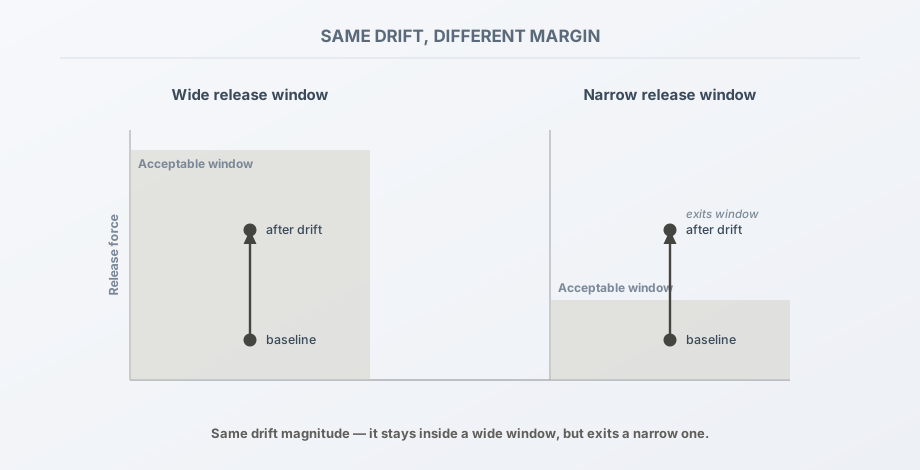
The same drift magnitude can be acceptable in one system and unacceptable in another. The determining factor is release window margin.
A system with wide acceptance boundaries can absorb drift and remain usable at extended dwell. A system operating near the edge of its acceptable range has much less buffer. The same drift can look manageable in one application and problematic in another.
Coating type can also influence drift profile as well as nominal release level. But the selection implications of that belong to the Material Selection pathway, not to this article.
When Drift Becomes a Different Kind of Question
The five-question check is a validation-layer tool. It applies when drift data exists and needs to be judged against expected system behavior.
If the drift is accompanied by visible residue on the adhesive surface, transfer to the liner, tearing during peel, or abnormal peel events not present at earlier dwell points, the question has changed. At that point, the right place for that is release force drift after storage — a different kind of analysis.