
When a Passing Result Becomes a Line Stop
The liner arrived with a data sheet. The initial release force was within the target range. A quick sample peel confirmed it. The team moved forward.
Three months later — after lamination, after shipment, after the product had been sitting in the customer’s warehouse — the peel force had climbed well past the usable window. The liner was not wrong. The selection logic was not wrong. The failure came from something more specific: the team had treated a single initial reading as evidence of how the liner would behave over time, and it was not.
That pattern — an initial pass followed by a later field failure — is not rare, and it is not caused by bad material. It is caused by a gap between what a Day 0 measurement actually captures and what production-grade performance actually requires.
This article explains that gap.
What a Day 0 Reading Can Answer — and What It Cannot
A Day 0 release measurement is a peel-force reading taken at a single point in time, under a single set of contact conditions, using a defined reference tape and test method. It tells you one thing with reasonable accuracy: how much force is required to separate the liner from that adhesive at that moment, under those conditions.
That is useful information. It is not evidence of stability.
What a Day 0 reading does not capture includes: the change in contact area as the adhesive wets out the liner surface over time; any shift in the interface driven by ongoing cure or post-cure reactions; any drift caused by storage temperature, humidity, or sustained pressure; and any change in surface energy as the coating stabilizes under real exposure conditions.
None of those variables are visible at time zero. The reading is accurate for the moment it was taken. The question is whether that moment represents the application’s actual service window — and in most silicone PSA contexts, it does not.
Why the Interface Is Not Stable at Time Zero
When a silicone pressure-sensitive adhesive contacts a release liner, the interface begins to change. The adhesive flows slowly into the surface topography of the coating. Contact area increases. The mechanical engagement between the adhesive and the coating surface deepens. This process — commonly called the dwell effect, or wet-out — happens over hours to days, not milliseconds.
The result is that peel force measured at the moment of contact, or within the first few hours, often does not represent the stabilized interface. In many silicone PSA systems, peel force at immediate contact is meaningfully different from peel force after 24 hours, and different again after 72 hours. That gap is not a defect. It is a predictable characteristic of how silicone adhesives interact with release surfaces.
A result that looks comfortably within range at time zero can move outside the usable window before the product reaches the customer.
When a silicone PSA contacts a release liner, the adhesive slowly wets out the coating surface. Contact area increases over hours to days — not at the moment of lay-down.
Peel force measured at immediate contact does not represent the stabilized interface. In most silicone PSA systems, the 24-hour reading differs meaningfully from the time-zero reading.
A result that looks acceptable at Day 0 can move outside the usable window before the product reaches the customer.
What Changes in the First 24–72 Hours
During the initial dwell period, the primary variable is contact geometry. The adhesive fills surface irregularities at the coating level, increasing the actual area of contact beyond what is present at lay-down. As contact area increases, the force required to separate the two surfaces increases with it — not because the material has changed, but because the physical contact state has changed.
In addition-cure silicone PSA systems, residual post-cure activity can also alter the adhesive’s modulus and flow characteristics during this period. That adds a second variable that does not appear in the initial reading.
Why Immediate Readings Are Often Difficult to Use as a Stable Baseline
Because the interface is still evolving at time zero, immediate readings often show higher variability than readings taken after the interface has stabilized. Two measurements taken within an hour of each other can differ more than two measurements taken after 48-hour dwell. That variability is not evidence of a poor liner. It is evidence that the reading was taken before the interface reached a consistent state. Using that early window as the primary decision point introduces avoidable uncertainty.
Why Release Force Does Not Always Change in One Direction
A common assumption is that if release force changes over time, it moves in one direction — either the liner gets easier to peel, or it gets harder. In silicone PSA systems, that assumption is not safe.
Release force over time is better described as a trend that must be measured, not a direction that can be assumed. Depending on the adhesive chemistry, the cure state at lamination, the coating composition, and the storage environment, the trajectory can include an initial rise, a stabilization period, and then a fall — or an initial drop followed by a slower climb — or a climb that plateaus and then reverses. Some of these transitions occur within the first week. Others take months to appear.
The implication for Day 0 data is direct. If the trend is non-monotonic, then a reading at any single point — including Day 0 — cannot predict where the curve is heading. A result that looks acceptable at the start of the dwell window might represent the bottom of an upward arc, or the top of a temporary peak. Without additional time points, those two situations look identical.
Decision-grade validation requires enough points along the time axis to tell them apart.
Release force over time is not simply heavier or lighter as aging progresses. The trajectory can rise, stabilize, fall back, or reverse direction — depending on the adhesive chemistry, cure state, and storage conditions.
A Day 0 result cannot predict the direction or shape of that curve. Trend data across multiple time points is required to determine whether the system is stable.
How Cure State Can Make Initial Release Readings Unreliable
An initial reading can also be affected by the cure state of the adhesive at the time of measurement. In addition-cure silicone PSA systems, the cross-linking reaction continues after the adhesive is formed. The rate at which it completes depends on post-cure exposure, temperature history, and catalyst loading. If the adhesive has not finished its cross-linking cycle when the initial peel test is run, the result reflects a partially cured system — not the stabilized chemistry the adhesive will present throughout its service life.
A Day 0 reading taken on material that was recently coated, recently laminated, or recently moved from a high-temperature process may not represent the adhesive the liner will interact with over the following weeks and months. Cure state at measurement time is a variable that should be tracked, not assumed away.
Note: how cure conditions should influence liner direction before testing is a prior selection-stage question. This section addresses a narrower point — how cure state at measurement time can distort the initial reading used as a validation baseline.
Accelerated Aging: Compressing the Time Window, Not Shortcutting the Work
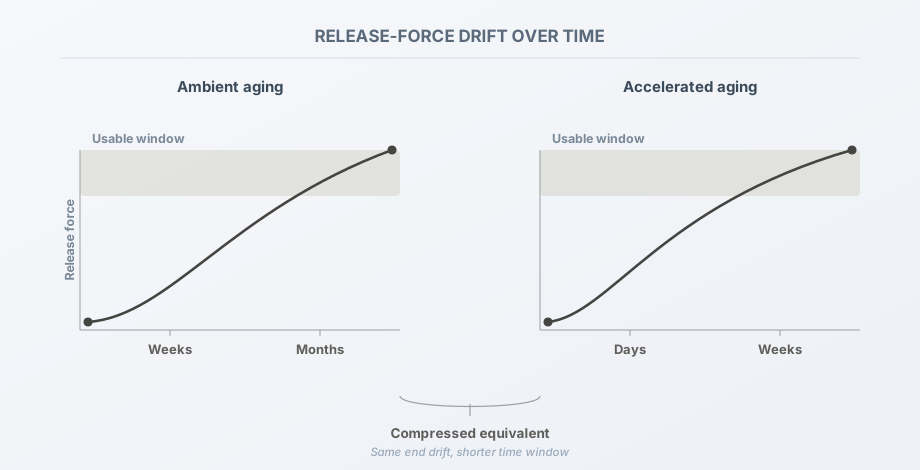
One practical response to the limits of Day 0 data is accelerated aging — using elevated temperature, elevated humidity, or both to compress the equivalent of months of ambient exposure into a shorter test window.
The logic is that release drift produced by long-term storage under ambient conditions can be made to occur more quickly under controlled thermal or hygrothermal stress. The aim is to detect release force drift or surface instability before shipment, not months after the product has reached the field.
The specific conditions — including temperature, humidity, and target equivalent time — should be defined based on the application domain, the adhesive system, and the claimed service life. Condition logic and reference standards differ across medical, electronics, and industrial applications. They cannot be used interchangeably. Choosing the right aging condition design is part of validation plan design, not a fixed universal specification.
Accelerated aging is a comparison tool. It compresses the waiting period, but the output still needs to be interpreted as trend evidence. Did the interface move? How far? In which direction? Does the aged state remain inside the usable window?
Accelerated aging data is most useful when compared against a clearly documented initial baseline. A result from an aged sample is most interpretable when the unaged starting point is known.
What Decision-Grade Evidence Actually Requires
The standard that separates a data sheet result from decision-grade evidence is trend coverage. A single result tells you where the system was at one point in time. A trend — multiple results taken at defined intervals across a meaningful time window — tells you where the system is going and how stable that trajectory is.
For most silicone PSA liner applications, decision-grade evidence typically includes:
- An initial reading taken after the interface has had sufficient time to reach a consistent contact state — not at immediate contact
- A short-dwell reading, typically at 24 hours, to capture the early wet-out response
- One or more readings after extended contact — 7 days, 30 days, or longer — depending on the expected service life
- At least one data point from accelerated aging exposure, to show how the system behaves under thermal or hygrothermal stress
- Consistency across those intervals within a defined usable range — not just a single acceptable value
The reference tape or adhesive used for these measurements also matters. A result generated against a generic internal test tape may not predict the behavior of the actual customer adhesive construction. Where the application-specific adhesive is available for testing, it is more decision-relevant than a laboratory reference alone.
Decision-grade evidence does not require a complex protocol. It requires enough time points, across a meaningful window, against a relevant adhesive reference, to show whether the system is stable.
- Initial reading — taken after contact stabilization, not at immediate lay-down
- 24-hour dwell reading — captures early wet-out response
- Extended reading — 7-day, 30-day, or longer, matched to service life
- Accelerated aging point — at least one exposure checkpoint
- Consistency — all intervals within a defined usable range
The reference adhesive matters. A generic test tape result may not predict behavior against the actual customer adhesive system.
Why the Starting Conditions Need to Be Documented
Trend data is most useful when the starting point is precisely known. If the Day 0 baseline reading is taken without documenting the coating weight, the adhesive cure state, the dwell conditions, and the reference tape used, then later readings — even if taken at the right intervals — cannot be reliably compared back to that baseline.
Fluorosilicone coating weight is a controllable variable. Documenting it at initial testing provides a physical reference that supports interpretation of later readings. If release force shifts after aging and the coating weight is known, the direction of investigation is more constrained than it would be without that information.
This is not a methodology requirement. It is a baseline discipline observation. Validation data is more interpretable when the starting conditions are defined, not assumed.
Three Assumptions That Day 0 Data Cannot Support
“The value on the spec sheet tells us how this liner will perform throughout its service life.”
Spec sheet values represent typical initial performance under the conditions used to generate them. They do not capture dwell-dependent changes, aging drift, or non-monotonic behavior. They are a starting reference, not a performance guarantee across a service window.
“A clean peel at Day 0 means there will be no residue or transfer concern over time.”
A visually clean initial peel reflects conditions at a single contact state. Whether the liner surface will remain clean after extended contact, storage, or aging is a separate question — one that requires time-based data, not an immediate observation. Residue or transfer issues in silicone PSA systems can develop gradually. Early cleanliness does not confirm long-term cleanliness.
“Our result matched the reference tape spec, so we are aligned with the customer requirement.”
Alignment with a generic test tape result does not automatically predict performance against the customer’s actual adhesive construction. Different silicone PSA chemistries interact with release surfaces differently. A result that is acceptable against one reference may not transfer directly to another system — even when the force values appear comparable.