
When a Number That Changed Feels Like an Answer
A release-force change after aging or storage does not point to one cause by itself. The first diagnostic value is not the size of the change. It is the direction of the shift, the pattern of the shift, and whether the comparison itself rests on a valid basis.
A common mistake is to treat any post-storage shift as proof that the liner is wrong. Another is to jump straight into mechanism discussion before sorting the symptom direction. Both moves create action risk. A liner gets replaced before the cause layer is identified. The cause remains. The next storage cycle produces the same result.
This article starts one step earlier. Before asking what caused the shift, it asks what the shift is actually pointing to.
Shift direction and shift pattern matter more than magnitude alone.
First Gate: Is the Comparison Interpretable?
Before reading the shift itself, the comparison basis needs to hold.
1. Was a valid Day 0 baseline collected?
If Day 0 was measured under non-comparable conditions — different test method, different peel speed, different conditioning time after production — the later result cannot be compared to it reliably. The shift may be real, but the reference point is too weak to carry the interpretation.
This is one of the most common first-check failures. Not because the test was poorly executed, but because the Day 0 conditions were not documented with enough specificity to serve as a reference point later. A shift calculated against an uncertain baseline is not a diagnostic signal. It is a measurement of the gap between two uncertain numbers.
2. Were the conditions comparable?
Aging and storage comparisons become unreliable when any of these vary without control between the reference sample and the aged sample:
- storage duration
- temperature
- humidity
- sample handling
- test timing after removal from storage
- adhesive lot basis
- liner lot basis
If the comparison basis is unstable, the shift may still be real. But the cause-direction conclusion is not yet reliable.
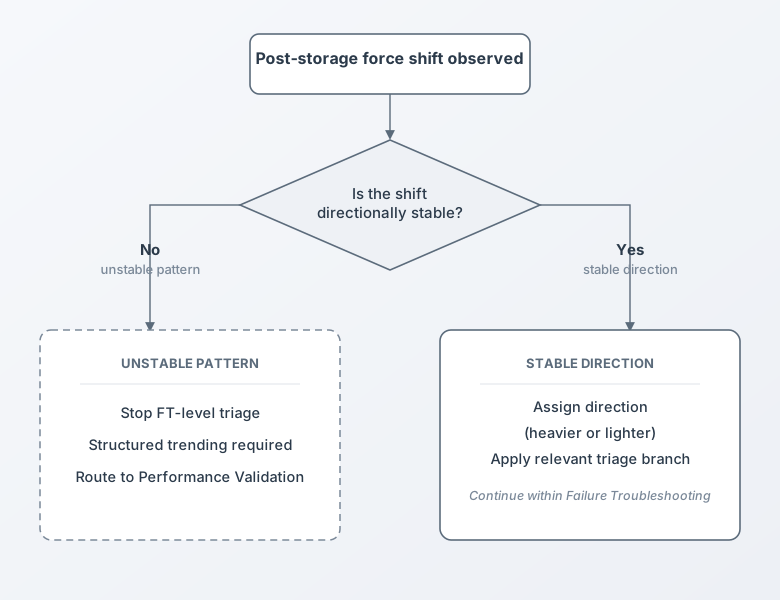
3. Is the shift directionally stable?
This is where the article separates into its main triage logic.
- If the shift is directionally heavier, start with the heavier-shift checks.
- If the shift is directionally lighter, start with the lighter-shift checks.
- If the shift is not directionally stable, do not force it into either branch yet.
That last case is not a third main branch. It is an escalation condition, handled separately below.
If the Shift Became Heavier
A heavier shift after aging or storage does not automatically mean liner failure. It first strengthens a few specific directions that should be checked before any corrective action is taken.
Direction 1: Expected interface evolution may still be active
In silicone PSA systems, some upward force drift after dwell is a recognized behavior pattern. As the liner and adhesive remain in contact over time, interface contact can increase. That can be measured as higher peel force at extended dwell relative to Day 0.
This does not prove the behavior is acceptable. It means the first check should not begin with automatic liner replacement.
Direction 2: The original release window may have been too tight
A system can start near the upper usable boundary on Day 0. After storage, a normal upward shift can push the force value outside the acceptable window, even if the shift itself is modest.
In that situation, the more useful reading is not that aging created a defect. It is that the original release margin may not have been adequate for the actual storage condition. That is a structural selection-stage issue, not a liner failure conclusion.
Direction 3: Storage exposure may have changed the stored interface condition
Temperature, humidity, and time can alter how the stored interface behaves. If the heavier shift appears after a defined storage window and remains consistent across comparable samples from the same lot and storage history, storage exposure itself becomes a stronger direction to inspect.
That still does not identify whether the dominant change is liner-side, adhesive-side, or interaction-driven. It only tells you where the first check should start.
A heavier shift is a direction signal, not a verdict.
If the Shift Became Lighter
A lighter shift after aging or storage is often misread as neutral or positive. That reading is unsafe.
A lower force may reduce concern in one narrow sense. But it can also point to a different kind of system change — one in which the interface has altered in a way that reduces mechanical resistance without improving system suitability. The right question is not whether lighter is better. The right question is what changed at the interface, and whether that change is stable and acceptable.
Direction 1: Liner-surface condition may have changed under storage exposure
One first-check direction is that storage exposure altered the liner-side release surface condition. If the release surface is no longer behaving as it did before storage, a lighter shift may reflect storage-related surface change rather than improved performance.
This direction is strengthened when the shift is larger than expected for the dwell period, when it is inconsistent across comparable samples, or when storage conditions deviated from the intended range.
Direction 2: Adhesive-side evolution may be changing the interface
The signal may also point toward the adhesive side. Cure-state evolution, interface response over time, or system-specific behavior changes under storage can alter how the construction separates, independently of what the liner coating did.
A lighter result from this direction may still be accompanied by adequate adhesive performance, or it may not. Force alone does not confirm which.
Direction 3: Storage conditions may have moved outside the intended range
When temperature, humidity, or duration moved outside the intended range during storage, the shift may reflect a condition deviation rather than a stable system behavior.
This becomes more relevant when a lighter result appears inconsistently across comparable samples, or when the shift correlates with a known storage excursion.
A lighter shift does not automatically mean the system improved.
Five Questions Before You Escalate
Neither direction produces a reliable cause-direction reading if the comparison basis is weak. These five questions form the core triage structure for this symptom.
| # | Question | Why it matters | What a weak answer means |
|---|---|---|---|
| 1 | Was a valid Day 0 baseline collected under comparable conditions — same method, speed, and conditioning? | Without a valid reference point, the shift cannot be measured reliably. | The shift may be real, but the comparison basis is too weak to support a direction conclusion. |
| 2 | Did the force shift heavier or lighter? | Direction is the primary sorting signal. | Cause-direction judgment cannot begin until direction is clear. |
| 3 | Is the pattern directionally stable — or does it change direction, stall and restart, or vary across comparable samples? | Pattern changes the meaning of the direction. | Structured trending may be needed before FT-level reasoning can continue. |
| 4 | Is the shift isolated to one lot or one storage location — or is it consistent across the system? | Localized shifts point toward condition-related or lot-related causes. System-wide shifts point toward consistent material or interface behavior. | A narrow pattern and a system-wide pattern do not point to the same first checks. |
| 5 | Did storage conditions — temperature, humidity, and duration — remain within the intended range throughout storage? | Exposure history can change the interface independently of nominal liner or adhesive properties. | The result may reflect a condition deviation rather than stable system behavior. |
If Question 1 cannot be answered clearly, the remaining four questions cannot be interpreted with confidence. Document the Day 0 conditions with enough specificity to make future comparisons valid before treating any post-storage result as a diagnostic signal.
When the Shift Is Not Directionally Stable
If the force shift does not hold a consistent direction — if it rises then falls, stabilizes then resumes, or shows inconsistent results across comparable samples under the same conditions — do not force the result into either the heavier or lighter framing.
This is not a third diagnostic branch. It is the escalation condition. Symptom-first triage has reached its useful limit.
The correct conclusion at this point is:
- direction cannot yet be assigned with confidence
- structured trending across defined time points is needed before any cause-direction judgment is made
- further FT-level reasoning should stop here
When the pattern is unstable, do not try to resolve it through additional single-point measurements. Single-point additions do not reconstruct a trend.
The next step is structured validation work. Dwell-time drift interpretation covers how to read a drift pattern once trending data is available. If structured confirmation requires defined aging conditions, aging-condition design addresses how those conditions should be scoped.
What This Symptom Most Commonly Leads People to Do Wrong
When engineers see a post-storage force shift, the first wrong move is often one of these:
- replacing the liner immediately
- treating a heavier result as automatic failure
- treating a lighter result as automatic improvement
- reading an unstable pattern as if it were a clean directional signal
- asking for mechanism depth before sorting the symptom state
- redesigning the aging test before confirming that the comparison itself was interpretable
This article does not solve the full interpretation problem. Its job is to stop those wrong first moves.
Closing Direction
A release-force shift after aging or storage is easy to over-read. The number changed, but the number alone is not the message.
Three checks come before any cause conclusion:
- Is the comparison valid?
- Did the shift become heavier or lighter?
- Is the pattern stable enough to interpret?
That sequence will not resolve every case. But it will keep the first action from being aimed at the wrong variable.