
The safer medical starting direction is the one that remains credible across adhesive severity, surface sensitivity, storage horizon, and construction reality — not simply the one that peels most easily at the beginning.
Medical Applications Are Not the Same Decision With Higher Requirements
In many industrial applications, liner selection can begin from one dominant variable. The engineer identifies the main constraint, narrows the candidate set, and then tests whether that direction holds.
In medical silicone PSA work, several selection pressures are often active at the same time.
When the liner sits inside a transdermal patch, a wearable device, an advanced wound care dressing, or another skin-contact construction, it is no longer functioning only as a temporary process material. It becomes part of a system in which adhesive condition, assembly behavior, storage exposure, and later program control all matter earlier than they do in standard industrial work.
That is why medical liner selection should not be treated as ordinary selection logic with stricter requirements added afterward. The issue is not only that the requirements are higher. The issue is that several selection pressures are often already active at the same time.
A medical program may simultaneously involve a stronger silicone PSA, a more surface-sensitive released adhesive, a longer laminated storage horizon, and less tolerance for late-stage correction. Once those pressures appear together, the risk is no longer a one-variable mismatch. It becomes a starting-direction problem.
So the opening selection question is not simply, “Which liner gives the right release force?” It is, “Which pressures are already active in this application, and which liner direction is still defensible when they are considered together?”
Not All Medical Applications Ask the Same Thing of a Liner
“Medical” is too broad to function as a selection rule by itself.
Wound care dressings, wearable fixation patches, and transdermal systems may all use silicone adhesive, but they do not stress the liner in the same way. A wound care construction may place more weight on gentle handling of the adhesive surface, comfortable removal, and stability across storage periods and dressing-change cycles. A higher-fixation wearable program may care more about interface severity, dwell stress, and whether the liner remains credible as the construction moves toward real assembly.
That is why the first narrowing step should be application family, not certification language. Certification and qualification depth matter later, but they do not tell the engineer what kind of liner pressure is already active at the start.
Before asking for a liner recommendation, it helps to identify which pressure is dominant:
- gentle skin performance with moderate fixation
- stronger fixation for longer wear time or higher device load
- a highly sensitive adhesive surface that cannot tolerate interface disturbance
- extended storage before end use
- demanding converting or laminated construction steps
Four Starting Pressures Define Medical Liner Selection
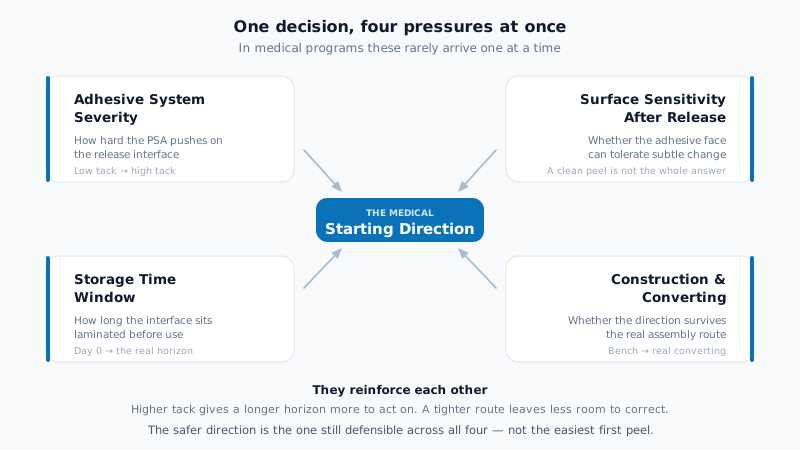
1. Adhesive System Severity
Medical silicone PSA systems span a wide range. At one end are softer, lower-tack wound care systems where atraumatic removal is the primary requirement. At the other are higher-tack systems used in wearables and longer-wear applications where secure fixation under movement and moisture is essential.
This range matters because the liner’s job changes across the tack spectrum.
At lower tack levels, a silicone-coated liner may provide adequate release performance and the selection decision is relatively forgiving. As adhesive tack increases, the release interface becomes more demanding. Higher-tack systems exert sustained stress on the liner surface during dwell, increasing the risk of release-force drift and narrowing the acceptable starting range. At the upper end of that range, coating chemistry may become a real selection variable earlier than expected.
That does not mean one coating direction should be assumed in advance. It means the engineer should ask, early, whether the specific PSA system has already made silicone versus fluorosilicone release coating a meaningful starting question.
2. Surface Sensitivity After Release
A clean peel event does not always mean the adhesive surface has remained in the right condition.
In medical applications, some constructions are more sensitive to subtle surface change after liner contact, even when the peel itself still looks acceptable. That matters more when the released adhesive surface must later contact skin consistently, maintain controlled fixation, or support a sensitive functional layer.
In those cases, the selection question is not only whether the liner releases cleanly. It is whether the liner direction preserves the adhesive surface state that the application actually needs.
That is why transfer-sensitive, skin-contact programs should assess whether silicone transfer risk and liner selection need to be considered together before the starting direction is fixed.
3. Storage Time Window and Dwell Trajectory
Medical products often carry longer laminated storage periods than early lab work suggests. A wound care dressing may sit in distribution for many months before end-user removal. A wearable program may need a longer laminated storage window than early bench work first implies.
Long laminated storage is not simply a longer version of short laminated storage. As dwell accumulates, the interface between the adhesive and liner surface evolves. A liner that looks acceptable at Day 0 may not remain acceptable later in the real program window.
The relevant starting-stage question is not only “what is the initial peel?” It is “what kind of release trajectory is likely over the real storage horizon, and is this direction still credible enough to carry forward?”
When that becomes a defining application constraint, the right next question is long-term storage selection, not more Day 0 debate.
4. Construction and Converting Sensitivity
Some medical structures are relatively tolerant at the converting stage. Others are not. Lamination sequence, stripping behavior, die-cutting sensitivity, and dimensional stability can all influence whether a liner direction remains workable as the product moves from trial samples toward real manufacturing.
This does not turn the article into an automated-converting page. It means the engineer should still check whether the proposed liner direction can survive the real construction logic of the product, rather than only a simplified bench condition.
In a medical context, the safer starting liner is often the one that remains credible under the real assembly route, not just under a controlled peel test.
Why These Four Pressures Have to Be Viewed Together
These four pressures matter not because each one is unusual on its own, but because medical programs often combine them in the same construction.
A higher-tack adhesive increases interface demand. A longer laminated storage horizon gives that interface more time to evolve. A more surface-sensitive application reduces tolerance for subtle disturbance after release. A tighter construction route leaves less room for a liner direction that only looks acceptable under simplified conditions.
That combination is what makes medical selection structurally different. The engineer is not choosing the liner that looks strongest on one variable. The engineer is choosing the direction that still remains credible when the variables start to reinforce each other.
Selection Should Start by Defining What Failure Looks Like
Once several pressures are active at the same time, a liner cannot be judged only by whether the first peel feels manageable.
That is why medical selection should begin by defining the failure the program most needs to avoid. In some applications, the main risk is difficult handling at removal. In others, it is adhesive-surface disturbance, release drift during storage, construction instability during lamination or conversion, or a late reset caused by a starting direction that looked acceptable too early.
Until that failure mode is defined, easy initial release can become a misleading shortcut. It may solve the most visible concern while leaving the more expensive one untouched.
- difficult handling at removal
- disturbance of the adhesive surface
- storage-related drift
- construction instability during lamination or conversion
- late-stage program reset because the original starting direction was too weak
Choose the liner direction that reduces the most important failure risk in the real application — not simply the one that gives the easiest initial peel.
A More Practical Starting Sequence for Medical Liner Selection
Wound care, wearable fixation, and transdermal programs may all use silicone PSA, but they do not carry the same dominant pressure.
Clarify whether the PSA system is still inside a forgiving range or whether tack and wear demand have already made the release interface more severe.
Ask whether the released adhesive surface can tolerate subtle change, or whether any interface disturbance will matter later.
Decide whether the real problem is Day 0 behavior or the longer trajectory under laminated storage.
Confirm that the proposed liner direction still makes sense once lamination, stripping, and downstream conversion are considered.
This sequence does not replace testing. It helps prevent the engineer from starting formal work from a direction that was too narrow, too convenient, or too optimistic.
What Early Compatibility Screening Is Actually Doing in Medical Work
Once a medically credible starting direction has been narrowed, the next task is to check whether that direction is plausible enough to justify deeper work.
In medical programs, that checkpoint matters early because a weak starting direction is often more expensive to replace later. The cost is not only lab time. It is the reset cost created when compatibility work has already started around the wrong candidate.
Early screening therefore serves a boundary function. It asks whether the proposed liner direction is credible enough across the active medical pressures to move forward into formal evaluation. It does not replace validation, and it does not reopen the selection question from the beginning.
The logic for that stage belongs in early compatibility screening for silicone PSA systems.
One Selection-Stage Confirmation Is Still Worth Seeing Early
Once the main technical pressures have been assessed and a starting liner direction has been identified, one further check is still worth seeing early.
Is there any obvious mismatch between the proposed liner direction and the level of program control this application is likely to require later?
This is not a request to solve documentation depth during selection. It is a caution against choosing a direction that looks technically usable now but is visibly misaligned with the likely structure of the program. How much qualification support the program should expect is a separate question that belongs to Regulatory & Qualification.
That check does not need to be completed at the selection stage. But it is still useful to surface before the project moves further forward.