
Three Cure Variables That Narrow the Starting Field
Most liner selection starts with adhesive chemistry, release target, and substrate family. Cure conditions add another layer. Three aspects matter most at the selection stage.
- Cure chemistry type — Addition-cure systems (platinum-catalyzed) are more sensitive to contamination at the liner interface than other cure types. If the liner is inside the cure window, its surface chemistry matters.
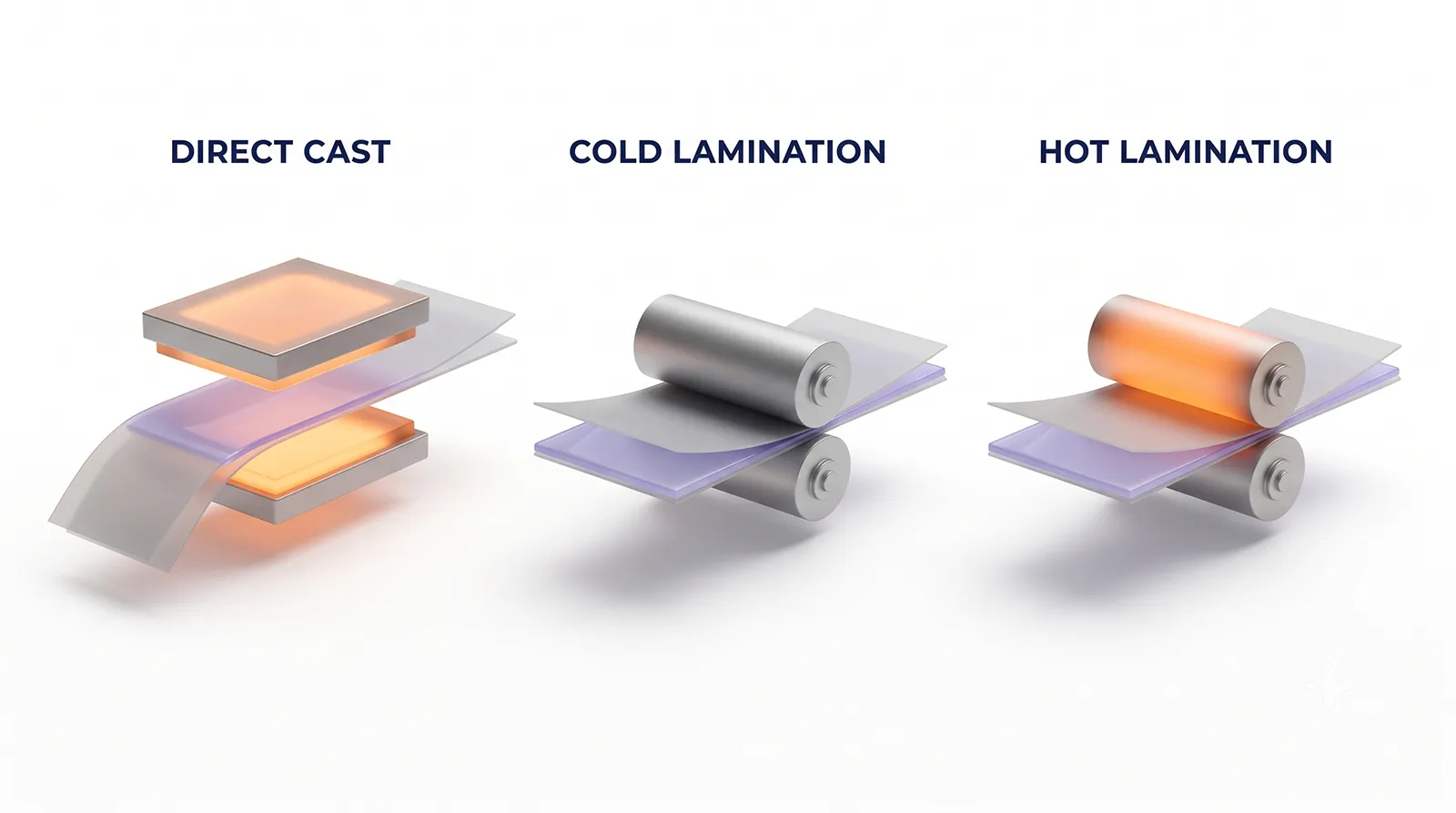
- Process format — Direct Cast, Cold Lamination, and Hot Lamination put the liner at different points in the process. Each format makes different demands on the liner.
- Temperature profile — Higher cure temperatures and longer dwell times put more thermal stress on the liner substrate, especially PET film.
Cure chemistry type. Addition-cure silicone PSA systems — typically platinum-catalyzed — are more sensitive to surface contamination at the liner interface than other cure types. Even very small amounts of residue or migrating material can interfere with the cure reaction. If the liner is inside the cure window during processing, its surface chemistry is not a neutral variable.
Process format. The process format determines what the liner actually goes through. Direct Cast, Cold Lamination, and Hot Lamination are different situations. They should not be evaluated the same way. The right starting liner direction depends on which format you are using.
Temperature profile. Higher cure temperatures and longer dwell times put more thermal stress on the liner substrate. This is most important when the substrate is PET film. A liner that works well at room temperature or with a short low-temperature dwell may not perform the same way during a long high-temperature cure cycle.
Direct Cast: What the Liner Must Survive
In Direct Cast, the adhesive is coated directly onto the liner. Both go through the curing oven together. The liner must survive the full cure cycle without warping or causing problems at the adhesive interface.
This creates two demands that do not exist — or are much less severe — in lamination formats.
Thermal dimensional stability. PET film stays dimensionally stable within a normal operating range. But above certain temperature and time limits, it starts to change shape — in both the machine direction and the cross-machine direction. If this happens during the cure cycle, it can cause registration errors, uneven tension in the adhesive layer, or surface defects that only appear after cooling. For Direct Cast with high cure temperature and long dwell time, PET thickness becomes a thermal process variable — not just a handling or die-cutting variable.
Interface compatibility during cure. In Direct Cast, the liner contacts the adhesive while the adhesive is still liquid or partly cured. Any material that migrates from the liner coating does so while the cure reaction is still active. For addition-cure systems, this raises a practical question: does anything from the liner surface interfere with the cure? A liner that performs well in post-cure contact may not be the right starting direction when contact happens during the cure window.
Cold Lamination and Hot Lamination: Different Starting Points
In both lamination formats, the adhesive cures first — on a carrier or release film. The liner is added later, for die-cutting, storage, or end use. The liner does not go through the main curing oven.
This removes two of the Direct Cast concerns. Cure interference is lower because the adhesive has already cross-linked before the liner makes contact. And the liner is not exposed to the full cure temperature.
But the two lamination formats are not the same.
The liner bonds to the adhesive using pressure only. No heat is applied during lamination.
Thermal dimensional stability is not a primary concern. The liner does not experience meaningful heat during the lamination step.
Main selection focus: post-cure release performance, aging stability, and interface cleanliness under dwell and storage conditions.
The liner bonds to the adhesive using both heat and pressure. The liner is exposed to thermal stress during the lamination step.
Thermal dimensional stability still matters — even though the liner does not go through the curing oven. The lamination temperature and pressure must be factored into the starting liner direction.
Main selection focus: thermal stability at lamination conditions, plus post-cure release performance and aging stability.
The key point is this: do not assume that all lamination formats are low-thermal situations. Hot Lamination still puts real thermal demand on the liner. A liner that works well in Cold Lamination may need to be re-evaluated for Hot Lamination.
Knowing which format you are using — and whether it involves heat — is a basic first step before any liner direction conversation begins.
Addition-Cure Systems: Why Surface Compatibility Matters Earlier
Addition-cure silicone PSA systems are widely used in high-performance applications. They are sensitive to certain surface chemistries and residues at the liner interface. This does not mean every fluorosilicone liner will cause problems with every addition-cure system. But it does mean surface compatibility should be considered at the selection stage — not discovered during testing.
Some cure-related interface problems do not show up as a large change in peel force. They may appear as slight tack loss, a cloudy adhesive surface, or soft cure in localized areas. If cure quality at the interface matters for your application, initial peel results alone may not be enough to confirm the starting direction.
Condensation-cure systems behave differently. The starting liner direction for a condensation-cure adhesive may be evaluated differently than for a platinum-catalyzed addition system — especially in Direct Cast, where liner and adhesive are in direct contact throughout the cure.
When the question shifts to how to read those early interface signals, that moves into early compatibility screening for silicone PSA systems.
Cure Temperature and PET: When Thickness Becomes a Process Variable
For Direct Cast processes with high cure temperatures, PET substrate type and thickness are part of the cure-condition decision. They are not a separate question.
Thin PET film may handle well in manual lamination or room-temperature die-cutting. But it may not be the right starting substrate for a high-temperature Direct Cast process. Thinner film can wrinkle or develop uneven tension during cool-down. This is especially true on wider webs or with longer oven dwell times. These problems may not appear on small lab samples but can become more noticeable at production scale.
When cure temperature and dwell time are high, thicker PET — or heat-stabilized PET designed for elevated-temperature use — may be a better starting choice. Make this decision before testing. Do not wait until a full sample run shows unexpected dimensional behavior.
The silicone versus fluorosilicone release coating choice is also affected. If cure temperature pushes the starting direction toward a more heat-stable substrate, the available substrate-and-coating combinations may already be narrower than they appear in standard liner catalogs.
For Hot Lamination formats, lamination temperature and pressure also affect this decision. If the lamination step uses meaningful heat, check whether the liner substrate remains dimensionally stable under those conditions as well.
What This Assessment Does Not Tell You
Knowing that your cure conditions point to a certain starting liner direction is not the same as proving that direction will work.
A liner direction that looks reasonable based on cure conditions still needs to be validated. Cure-condition screening helps rule out weak starting points before testing begins. It does not replace testing.
Whether the chosen direction gives stable release over aging and dwell, how release force changes after thermal exposure, whether any drift occurs under your actual process and storage conditions — those are performance validation questions, not pre-selection questions. Once cure-condition logic has narrowed the starting direction, the next step belongs to performance validation. How aging condition design fits that process is a separate question — one that depends on the confirmed direction, not the starting one.
Three Questions to Answer Before Selecting Samples
Before choosing liner samples, a basic cure-condition review should answer three questions.
Addition, condensation, or another mechanism — and does it create interface sensitivity that should affect the starting coating choice?
Direct Cast, Cold Lamination, or Hot Lamination? If it is Hot Lamination, what are the lamination temperature and pressure conditions? Does the liner see meaningful heat during bonding?
For Direct Cast, do they make PET substrate type and thickness a thermal process variable? For Hot Lamination, do the bonding conditions add additional thermal requirements for the liner?
If these questions can be answered before the first sample is specified, the starting liner direction can usually be narrowed with fewer dead ends. Samples can be chosen from a shorter, more defensible list. The first round of work is also more likely to reflect what actually happens in the process — not just a simplified lab setting.
Cure conditions are not always the most important selection variable. But when the adhesive system uses high-temperature curing — especially in Direct Cast or Hot Lamination formats, or with platinum-catalyzed chemistry — they should be reviewed before the starting direction is fixed. Otherwise, the first round of samples may be based on a starting logic that was already incomplete.