
This article starts after a corrective action has already been taken. If you are still at the first-check stage — before any correction has been attempted — silicone transfer or residue after liner removal covers that step first.
A persistent surface problem after a liner or process change is not only a quality problem. It is a diagnostic signal.
The change was made. The problem stayed. The mark is still there. The downstream tack is still low. The converting defect still appears in the same position. Most teams read that result as “we haven’t found the right fix yet.” That keeps them searching in the same direction.
A more useful reading is simpler: “this failed change just told us something about the mechanism.”
This article is about how to use that information.
Changing a variable is not the same as testing a cause. A failed liner change or process adjustment carries diagnostic information about the mechanism. Using that information — instead of escalating the same corrective action — is usually the faster path to resolution.
The Persistence Is Not Just a Setback — It Is New Evidence
What the corrective action was actually testing
A liner swap, a cure adjustment, or a broader process change is never just an operational action. Each one carries an implied mechanism hypothesis.
If you changed the liner, the implied assumption was that liner-side factors were a major driver. If you changed cure conditions, the implied assumption was that cure state, anchorage, or process-related formation was the main direction.
If the surface problem persists after that action, the result should be read as a test of the hypothesis behind it. The action itself may still have been reasonable. But its failure means the earlier cause classification may have been incomplete, too narrow, or wrong.
When engineers say a corrective action did not work, they often mean only that the problem is still there. That is true, but it is not enough. The more important question is: what did that failed action just tell us about the mechanism?
Why changing a variable is not the same as testing a cause
A corrective action only produces a clear diagnostic result when the change was isolated, the right outcome metric was used, and the comparison was made against a stable reference.
In most production troubleshooting, those conditions are not fully met. The liner was changed, but the adhesive lot may also have changed. The cure temperature was adjusted, but ambient humidity shifted. The tracked result was peel force, but the surface condition affecting downstream performance was never directly measured.
That is why the next question should not be “what else should we try?” It should be: “what was this correction actually testing — and what does its failure tell us about the mechanism?”
Without that step, troubleshooting becomes a sequence of interventions, not a sequence of diagnosis.
What a Failed Liner Change Is Actually Telling You
What liner-change persistence weakens
When the surface problem persists after a liner change — across different lots, or after switching between standard silicone and fluorosilicone release coatings — that result weakens the hypothesis that liner-side transfer or liner-specific migration is the dominant cause.
It does not eliminate liner origin entirely. The replacement liner may still interact with the adhesive in a similar way. The change may not have isolated the variable as cleanly as intended. But these become secondary questions, not the main one.
The primary signal is this: the mechanism likely extends beyond liner coating origin.
The escalation trap
This is where teams often make a costly mistake. They interpret persistence after one liner change as evidence that they need a more aggressive liner adjustment. They move from one lot to another, or from one coating family to another — without first asking whether the liner hypothesis itself has already been weakened. That is how troubleshooting turns into repeated re-selection without real mechanism separation. The search space widens, but the actual cause remains untested.
A more disciplined reading stops that pattern. If the liner changed and the surface problem did not, the next step is not automatically another liner change.
What liner-change persistence makes more likely
When liner-side origin is weakened, other directions carry more diagnostic weight:
Adhesive-side condition. Incomplete cure, post-cure instability, or anchorage failure in the adhesive layer can produce surface contamination that originates from the adhesive side, not the liner side. Switching the liner does not change the adhesive cure state.
Cure inhibition or reactive interface behavior. In some silicone PSA systems, chemical interaction at the liner-adhesive interface can interfere with cure completeness or generate reactive surface products. This can persist regardless of liner coating type because the reactivity is driven by adhesive chemistry and cure conditions, not by the liner alone.
Unchanged process or exposure variables. If the problem is tied to converting, storage, or thermal history that did not change when the liner was changed, the root cause may sit there instead.
A failed liner change weakens the hypothesis that liner coating origin is the dominant cause. It raises the priority of adhesive-side condition, cure-related behavior, and unchanged process variables.
What a Failed Process Change Is Actually Telling You
What process-change persistence weakens
When a process adjustment — cure temperature, dwell time, line speed, pressure — does not resolve the surface problem, that result weakens the hypothesis that the dominant cause is a process variable operating outside its intended range.
It does not eliminate process contribution. The adjustment may have been too small. A different process variable may still matter. But if the adjusted variable was the main suspected cause and the problem did not change, that explanation has lost strength.
The sense-of-action problem
Process changes often create a strong sense of action. The team feels it has addressed the real manufacturing cause. When the symptom remains, that failure is often treated as a process optimization issue rather than a mechanism-diagnosis issue.
The result is more tuning, more line changes, and more local adjustment attempts — even though the original cause direction has already been weakened.
The more useful question is not whether the process can still be adjusted further. It is whether the process change was aimed at the wrong primary mechanism. If it was, additional optimization adds noise without narrowing the diagnosis.
What process-change persistence makes more likely
When process-variable origin is weakened, the remaining candidates gain weight:
Material-side mismatch. If the surface problem persists despite process adjustments within the normal operating range, the cause may be structural — a fundamental incompatibility between the liner coating and the adhesive system that process optimization cannot remove.
Exposure history outside the process window. If storage conditions, incoming lot variation, or pre-process handling introduced a condition that the process change does not address, the root cause may predate the adjusted process step.
Combined mechanism. When both liner and process changes have been tried and the problem persists, more than one variable may be contributing. In that case, further correction is less useful than variable isolation.
The False Resolution Pattern
When one indicator improves but the mechanism remains active
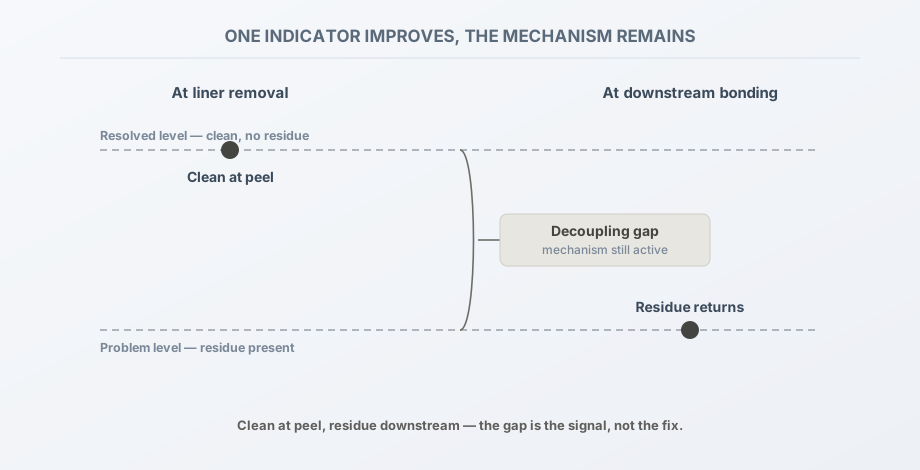
False resolution is a pattern that delays correct diagnosis. It happens when one measured indicator improves after a corrective action, but the underlying mechanism remains active.
The most common example in silicone PSA troubleshooting is this: peel force returns to an acceptable range after a liner change or process adjustment, and the team concludes the problem is resolved. But downstream adhesion performance, surface energy, or functional bonding outcome still falls short.
Those indicators are not measuring the same thing. Peel force measures the energy required to separate the liner from the adhesive at removal. Downstream adhesion measures the condition of the adhesive surface after removal — which may have been altered by migration, cure-state variation, or interface reaction during contact.
When peel force and downstream performance point in different directions, peel-force improvement is not a resolution. It is a decoupling signal.
Which indicator actually confirms the mechanism
Before concluding that a corrective action resolved the problem, ask one explicit question: does the indicator that improved have a direct causal connection to the mechanism that was hypothesized?
If the hypothesis was liner-side migration, the confirming indicator is downstream adhesion performance or surface condition — not peel force.
If the hypothesis was cure-state instability, the confirming indicator is cure-completeness evidence and stable downstream performance — not visual appearance at peel.
An indicator may improve because it is sensitive to the adjusted variable, yet still fail to confirm the actual mechanism. That creates the appearance of progress without real cause resolution.
The safer question is not simply whether something improved. It is: which improvement would actually support the current diagnosis? If that link is unclear, the improvement may not mean what the team thinks it means.
When one indicator improves and another does not, that gap is itself a diagnostic signal. The changed indicator must be logically connected to the mechanism being tested. If that connection is weak, the correction result is weaker than it looks.
Three Questions to Reset the Diagnosis
When a corrective action has failed — or produced only partial improvement — these three questions provide a structured way to re-examine the original mechanism hypothesis.
Question 1: What was the original mechanism hypothesis, and what observation actually supported it?
Most initial diagnoses in production troubleshooting are based on pattern recognition. The symptom looks like transfer. The last change was a liner lot. So liner-side origin seems likely. That reasoning is not necessarily wrong. But it is often not supported by direct evidence.
The first reset step is to identify what observation supported the original hypothesis — and whether that observation was actually enough to support mechanism origin.
Question 2: What did the corrective action actually test — and what does its failure eliminate as a premise?
A liner swap tests one type of assumption. A cure adjustment tests another. A broader process change may test several variables at once, but often less cleanly.
State clearly what the action was meant to confirm or disprove. Then state clearly what its failure has now weakened. That is how you narrow the field.
Question 3: What does the persistent symptom now make less likely, and what does it make more likely?
After one or more corrective actions have been tried, the space of likely causes is narrower. Some directions have been weakened. The strongest remaining candidates are often the ones the previous changes did not address.
The goal is to identify the strongest remaining candidate based on what is now known — not on the original pattern recognition.
These questions do not require analytical testing. They require reading the result of previous corrective actions as diagnostic evidence rather than as unexplained failure.
Where to Go From Here
The re-examination above should produce a revised direction. Use the table below to identify the next step.
| Re-examined direction | What this means | Next step |
|---|---|---|
| Adhesive-side condition — incomplete cure, anchorage failure, cohesive instability | Liner change did not fix it because the mechanism is in the adhesive, not the liner | Adhesion loss after liner removal → adhesive integrity inspection |
| Liner chemistry or coating architecture — structural incompatibility, not just lot variation | The liner direction itself may have been wrong from the start | Silicone transfer risk and liner selection |
| Reactive interface or cure-related behavior — mechanism persists independently of liner type | The interaction is driven by adhesive chemistry or cure conditions, not liner coating identity | Multi-variable check for coordinated interpretation |
| Combined mechanism — problem persists despite multiple changes | More than one variable is contributing; adjusting them simultaneously has not isolated cause | Controlled variable isolation before any further corrective action |
| Still at first-observation stage — no corrective action taken yet | This article is not the right starting point | Silicone transfer or residue after liner removal |
A failed correction is not dead work. It is a turning point in the investigation. The surface problem that persists after a liner or process change is telling you that the first explanation may no longer be strong enough. Used correctly, the result of a failed corrective action is the clearest evidence available for choosing the next direction.