
This article is about prospective qualification continuity. It asks which supplier-side changes can place an already-approved program at risk, and how change-control expectations should be set before those changes happen. If the question has moved to structured validation evidence across multiple production lots, that belongs to the cross-lot stability article in Performance Validation. If a performance shift has already appeared and the question is how to use change-control records during failure diagnosis, that belongs to the troubleshooting article on unexplained result changes.
Why Approval and Supply Condition Can Diverge
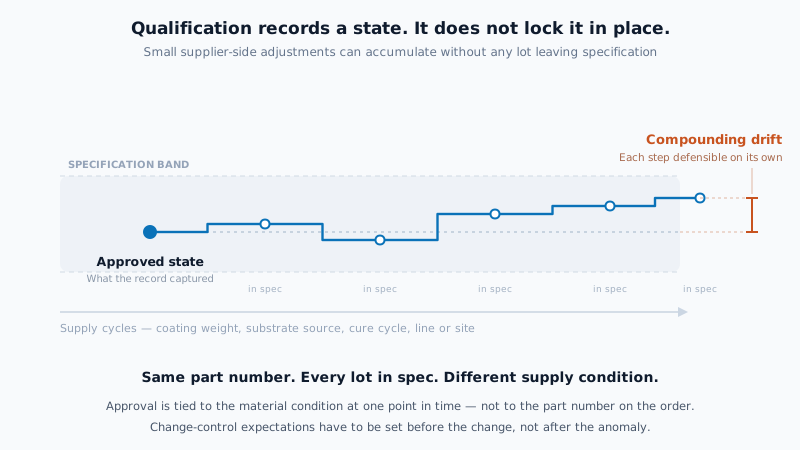
Qualification records a state. It does not lock that state in place.
When a program approves a liner direction, that approval is tied to a specific material condition at a specific time. It reflects the formulation as coated, the substrate as sourced, the release weight as produced, and the cure cycle as run. The approval record shows what was tested and what it met. It does not guarantee that the material will remain in that same condition through future supply cycles.
A great deal can change on the supplier side without any single shipment failing its specification. Coating weight can drift within the accepted tolerance band. Base film can shift to another source within an approved family. Release-coat formulation can be adjusted to accommodate a raw-material change or improve process yield. Cure parameters can be revised within validated operating ranges. These changes are part of normal manufacturing management. They do not automatically mean supplier failure. But they can move the material away from the condition the program was originally built around, while the receiving team has no way to see that the shift occurred.
The more serious risk is often not one large change. It is compounding drift. Several small adjustments, each individually defensible and still within specification, can accumulate across supply cycles into a performance shift that the receiving team reads as a validation anomaly or a process problem. The COA passes. The specification passes. The team cannot find a downstream cause. Weeks later, a supplier discussion or a lot timeline review reveals that a coating-weight adjustment or a substrate transition had occurred several supply cycles earlier. Each individual change was reasonable. The sequence was never made visible. The investigation cost was real.
That is the structural gap this article addresses:
“this lot passed conformance inspection”
is not the same as
“the supply condition the program was approved against is still intact.”
More documents do not close this gap. A TDS defines nominal product properties. A COA confirms that a specific lot met specification at the time it was issued. Neither document proves that the specific formulation, substrate, coating-weight distribution, and cure state that the qualification was built around have remained consistent since approval.
A supplier-side change does not need to be large to disrupt qualification continuity. What matters is whether the change moved a variable that the original qualification was built around, and whether the program had any mechanism for knowing the change occurred. More documentation does not create continuity protection. Only an explicit change-notification expectation can do that.
Which Change Categories Carry the Most Continuity Risk
Not every supplier-side change carries the same continuity risk. Some changes may be technically significant in absolute terms but have limited effect on the release interaction. Others may look small, yet directly affect variables that participate in how the liner performs in a silicone PSA system. The real question is not how large the change is — it is how directly the changed variable participates in the release interface, and therefore how directly it can alter the performance characteristics that the program’s qualification was built around.
Release coating formulation
The release coating is the variable most directly tied to release force, long-term release stability, and transfer risk. A formulation change can shift long-term behavior even when the shipment still meets the release-force specification at the time of supply. Chemistry adjustments made for supplier process reasons can change the density or distribution of interface-active species without changing the Day-0 release result. This is one of the highest-risk change categories.
Coating weight and thickness
Coating weight affects where the liner sits within its release range. A liner operating at the light end of its approved band can behave differently under extended dwell than the same liner operating at the heavy end, even if both still pass the same specification. A product can remain within specification at the supplier level and still move enough to change the operating margin of the application. Release stability, aging behavior, and transfer threshold can all move with it.
Base film substrate or grade
The substrate affects dimensional stability under tension, release-coat anchorage, and — where relevant — the uncoated-side surface energy that influences winding or backside interaction. A substrate change that looks equivalent on paper can behave differently under converting tension, over time, or in demanding thermal environments. Suppliers may treat such changes as internal sourcing decisions because the nominal substrate specification remains met. From the program side, the substrate is part of the approved construction.
Cure chemistry and cure cycle
Cure affects cross-link density in the release coating and the amount of residual low-molecular-weight species at the PSA interface. Supplier-side cure changes made to improve throughput, adapt to a different oven profile, or respond to a raw-material shift can alter long-term release stability without creating any obvious difference at incoming inspection. Their effects often appear later under dwell or aging, not at receipt.
Manufacturing site or production line
A site transfer, line consolidation, or move between coating heads introduces a different set of process-condition distributions. Coating uniformity, web tension profile, drying gradients, and winding history may all shift even if the supplier carries forward the same nominal settings. Process capability does not automatically transfer from one line or site to another. The approved construction was built on one set of operating conditions. A site or line move can reset those conditions without changing the product code.
Coating line conditions
Line speed, drying profile, and coating conditions interact with formulation to affect coating uniformity, cure completeness, and cross-web consistency. A product can remain within specification while its actual distribution inside the specification band shifts. Programs with narrow release windows are especially sensitive to this kind of change.
Packaging configuration and roll geometry
Winding tension and roll geometry shape the pressure history within a stored roll. Tighter winding, larger diameters, or different core types create different stress histories during storage. That can affect release-force variation between the inner and outer parts of the roll — differences often invisible at incoming inspection but visible in converting. In programs where within-roll or roll-to-roll consistency matters, packaging and winding changes are continuity-relevant.
Specification range revision
A supplier-side revision to product specification can also affect continuity. Widening a release-force range, adjusting a thickness tolerance, or changing another acceptance window may look administrative from the supplier side. From the program side, it changes what future COA-passing lots may represent. If the original qualification covered one narrower region, a later broader specification can allow incoming lots that sit outside what the original program ever tested.
“this lot passed conformance inspection”
is not the same as
“the supply condition the program was approved against is still intact.”
| Change Category | Primary Performance Variable Affected | Continuity Risk |
|---|---|---|
| Release coating formulation | PSA interface chemistry; aging and dwell behavior; transfer risk | High |
| Coating weight / thickness | Release-force level; aging stability; transfer threshold | High |
| Base film substrate or grade | Dimensional stability; coating anchorage; uncoated-side surface energy | High |
| Cure chemistry or cure cycle | Cross-link density; residual reactive species; long-term release stability | High |
| Manufacturing site or production line | Process-condition distribution; coating uniformity; winding history | Medium–High |
| Coating line conditions | Uniformity; cure completeness; within-band position | Medium |
| Packaging and roll geometry | Winding pressure; inner/outer diameter variation; storage deformation | Medium |
| Specification range revision | Approved-lot envelope; what future COA-passing lots may represent | High |
Risk reflects how directly the variable participates in the release interface and qualification basis. It does not imply that every program must treat each category in the same way.
Why the Timing of Change-Control Expectations Matters
A program usually learns of a supplier-side change in one of two ways: before the changed material enters production, or after a downstream effect appears. These two situations may look similar from the outside. In practice, they are structurally different.
When a program learns of a change before implementation, the receiving team still has options. It can assess the technical significance of the change against what the original qualification actually covered. If the change remains within the tested envelope, the judgment can be documented and the program can continue without disruption. If the change falls outside that envelope, targeted evaluation can be run before the changed material enters the production supply chain — while both original and changed material may still be available for comparison.
When a program learns of a change only after a release-force shift, converting complaint, or field concern appears, the position is much weaker. The changed material may already be in use. The lots that crossed the change boundary may be mixed with other inventory. The investigation must work backward while an active quality event is underway. Side-by-side comparison may no longer be practical. The documentation that would have made the transition clear and defensible does not exist.
That is the structural case for prospective change-control expectations. It is not mainly about paperwork. It is about preserving decision space. A change-notification expectation set before the program is running gives the receiving team the chance to act before a change becomes a problem. A change-notification request raised only after a problem appears is no longer a control tool — it is an investigation tool.
When the expectation is unclear, a predictable three-part failure sequence follows. The supplier classifies a change as minor because it remains inside its own internal control framework. The buyer classifies the same change as continuity-relevant because the application was approved around a narrower assumption. Neither side recognises the mismatch until the program is already exposed. At that point, the conversation is no longer a forward-looking alignment discussion. It becomes a recovery discussion. A mismatch in expectation is not the same as supplier failure. In most cases, the gap exists because the support depth the program needed was never made explicit.
Three common misconceptions often prevent teams from setting these expectations early enough.
The first: “approved once means future changes are automatically covered.” Qualification records a supply condition. It does not govern it.
The second: “if we have lot traceability, we have change control.” Lot traceability answers which lot was involved. It does not answer whether the formulation, substrate, coating weight, or process behind that lot changed after qualification.
The third: “more documentation means more continuity protection.” A larger document package does not protect qualification continuity. A COA confirms lot conformance at issuance. A TDS defines nominal product properties. What those documents actually prove is bounded — neither proves that the specific supply condition the program depends on remains intact.
What Change-Control Expectations Should Actually Cover
A workable change-control expectation does not always require a formal agreement. But it does require certain points to be made explicit before the program depends on them.
Which change families the program considers continuity-relevant. Not every supplier-side adjustment needs customer notification. The important point is that a program should not leave high-risk continuity variables undefined. If the qualification was built around coating formulation, coating weight, substrate, cure state, or manufacturing site, then changes to those variables should not remain invisible by default.
What kind of notice is expected when those changes occur. A notice delivered after the changed material has already shipped does not create real decision space. A notice delivered early enough to allow technical review or targeted comparison preserves options. The right lead time depends on the application, the review burden, and the pace of the validation cycle. This expectation is most useful when stated as a defined advance window rather than a general principle.
In what form the communication should arrive. The communication should be substantive enough to support a decision. It should identify what changed, when the change takes effect, and what internal basis the supplier used to judge that the product remains within its defined scope. This does not require a regulatory-style submission in every case.
Who is responsible for identifying that a change has crossed from normal supply management into qualification relevance. This is the element most often left undefined. Both sides may assume the other will flag it. Without explicit agreement on where this threshold sits, the notification system remains weak even when both parties consider themselves to be acting reasonably.
Not every program requires the same change-control depth. Some supply relationships operate at a baseline level, where routine quality practice and standard shipment documents are sufficient. Others operate at an enhanced level, where proactive change notification is a practical requirement because downstream consequence or audit exposure is higher. A smaller group of programs require an explicit agreement — with defined scope, timing, and communication format — because the application’s qualification framework demands it. The full framing for determining which level applies belongs to the article on qualification depth and supplier support framing.
The relevant question is not whether every serious supplier should already provide the same model. The relevant question is which level of continuity control this specific program can no longer treat as optional.
How Programs Discover Change-Control Gaps
Most programs do not discover weak change-control expectations during planning. They discover them through a problem.
Release-force drift with no visible cause
Production data begins to move. Release force is heavier or lighter than the program’s normal operating centre. The team checks process settings, adhesive lot, dwell time, storage condition, and test method. None explains the shift. The current liner lot still passes normal incoming checks. The issue looks intermittent or lot-specific. Weeks later, a supplier discussion and lot timeline review reveal that a coating-weight adjustment or substrate transition had taken place several supply cycles earlier. The change was within specification. It was within supplier operating authority. It was not communicated. The investigation cost was avoidable.
Qualification-record challenge in audit or review
A customer audit or formal review asks the program to show that the supply condition behind the approved liner configuration has remained stable since qualification. The program cannot show that — not because a harmful change is confirmed, but because the mechanism for detecting and documenting supplier-side changes was never established. The gap is not about one visible event. It is about the absence of a documented basis for saying the approved condition is still intact. Establishing that basis retroactively, mid-audit, is more difficult and more disruptive than establishing it prospectively as part of the qualification structure.
Manufacturing-site transition
A supplier consolidates production or transfers a product to another line or site. The product code remains unchanged. The COA format remains unchanged. The nominal specification remains unchanged. But the approved construction was originally produced under a different set of process conditions. The first sign of the transition may not be a formal notice. It may be a subtle shift in release uniformity, within-roll variation, or a surface condition not present in earlier lots. The program is then left with an approved material record tied to conditions that no longer apply, without a documented transition or an assessed acceptance basis.
These patterns all share the same root: the program depended on an assumption of supply stability that was never made explicit as an expectation.
When Change-Control Logic Connects to Re-Qualification
This article does not define which change types universally require re-qualification — the correct response depends on application sensitivity, original qualification scope, change type, and the surrounding quality framework. What can be stated clearly is the logic that connects change awareness to re-qualification decisions.
If a change stays within the envelope that the original qualification explicitly or implicitly covered, it does not automatically require re-qualification. But that judgment still needs to be made deliberately and documented clearly. It does not happen by default.
If a change moves the material outside the tested envelope, the program has to decide how to respond. In some cases, the existing qualification may be extendable by technical reasoning. In others, targeted re-testing may be needed. In more sensitive programs, broader re-qualification may be justified. The correct response depends on how far the change moves the material, how sensitive the downstream application is, and what the quality framework requires.
From a control perspective, the most important distinction is between two outcomes:
- A change the program knew, assessed, and accepted — documented record, clear transition basis, qualification management event.
- A change the program did not know occurred — no record, found in a failure investigation, qualification-continuity failure.
A documented and accepted change is a qualification-management event with a clear record. An undocumented change found only during a failure investigation is a qualification-continuity failure — there is no record that the relevant change was ever known, let alone reviewed.
That is the function of change-control expectations. A program with clear notification expectations can learn of consequential changes early enough to make a deliberate decision. A program without that mechanism may only learn of the change after a problem appears — when decision space is already smaller and comparison options are already weaker.
The structured validation logic for demonstrating stability across multiple production lots and supply cycles belongs to the cross-lot stability article in Performance Validation. That article owns the evidence framework. This article owns the earlier question: how to keep the qualification record connected to what is actually being supplied.