
A liner program can run for a long time with basic documents and no obvious control failure. The threshold changes when the team must answer a narrower question: not what product was supplied, but which lot was actually involved.
That is the point where lot traceability stops being a background quality preference and becomes an operational requirement.
A complaint, a containment action, or a customer review does not ask for general product identity. It asks whether the implicated material can be isolated with enough confidence to support the next decision. If that linkage is missing, the problem is no longer only documentary. It becomes operational.
A common assumption makes this harder to see. Teams often treat a COA with a lot number as if it means the traceability question is already covered. In practice, that may be only the starting point.
When an Investigation Opens and Lot Linkage Is Missing
The traceability gap often stays invisible until an investigation begins.
During routine supply, the available records may appear sufficient. The team knows the product name. The supplier is known. The shipment documents are on file. A COA may also be present. Nothing in that document set looks obviously incomplete.
The situation changes when a narrower question appears. A complaint may point to one production period. A hold decision may require the team to define the affected scope. A customer review may ask whether a specific finished batch used a specific incoming liner lot.
At that point, general identification is no longer enough.
The team may be able to confirm what product family was ordered. It may be able to confirm which supplier shipped the material. It may even be able to identify a lot number on the supplier document. But if the chain between supplied lot and actual use was never maintained, the investigation cannot move cleanly from product identity to lot implication.
That is the practical threshold this article addresses.
Lot traceability becomes necessary when the program must isolate which lot was involved, not merely identify what product was supplied.
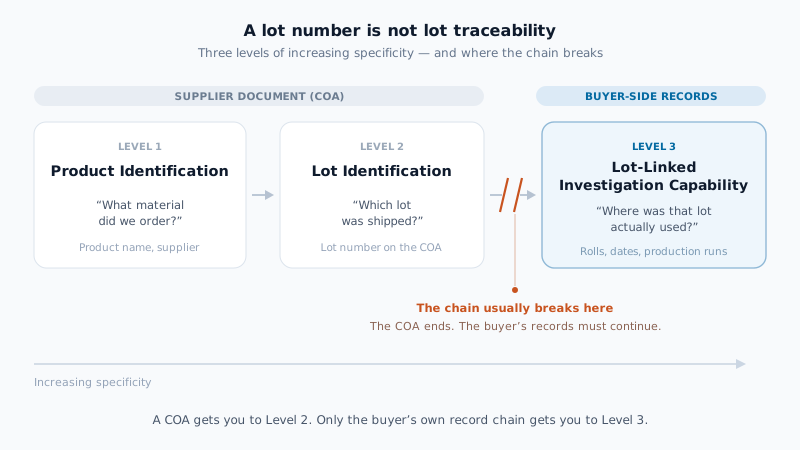
Three Levels: Product Identification, Lot Identification, and Lot-Linked Investigation Capability
These three states are often treated as if they were equivalent. They are not.
Product identification answers a broad supply question. It tells the team what material was ordered or received. This may be enough for routine commercial handling. It is not enough for a narrow investigation.
Lot identification answers a narrower supplier-side question. It tells the team which batch or lot was shipped. A COA often supports this level well, and that has real value. It narrows the material identity beyond the product code.
Lot-linked investigation capability answers the operational question that matters when pressure appears. It tells the team whether the identified lot can be connected to actual buyer-side use in a way that supports isolation, containment, and review.
That third layer is where many programs discover the gap.
A COA with a lot number may confirm the supplier lot at the relevant inspection point. It does not automatically prove which rolls from that lot were received into use, which dates they were used, which production runs consumed them, or which complaint-implicated finished units included material from that lot.
This is why a COA with lot references is not the same as lot-linked investigation capability. What each of those supplier documents can actually prove is a separate question with its own boundary.
The problem is often not that the document is wrong. The problem is that the linkage between documents was never maintained to the depth the investigation requires. That connection does not live in the supplier’s COA. It lives in the buyer’s incoming records — the chain that ties the supplied lot to actual production use.
A COA with a lot number supports lot identification. It does not automatically provide lot-linked investigation capability. That capability depends on the buyer-side record chain that ties the supplied lot to actual production use — not on the supplier document alone.
When Does Lot Traceability Become Operationally Necessary?
Not every program needs the same traceability depth. This article should not be read as saying that every silicone adhesive liner program requires the deepest possible lot-linkage model from the start. The right depth depends on the program context.
The practical question is different. It is this: when does a lighter model stop being operationally sufficient?
Three activation contexts usually define that threshold.
Complaint Handling
A complaint creates immediate pressure to narrow the question. If the team needs to know whether one incoming liner lot may be linked to one production period, one finished batch, or one customer event, product-level identification is no longer enough. The program now needs lot linkage that can support a narrower answer.
Without that linkage, the investigation may stay broad and uncertain. The team may suspect a lot relationship without being able to establish it responsibly.
Containment Decisions
Containment requires scope discipline. If a possible issue is under review, the team needs to know whether the affected range can be narrowed to a defined material input window. Without lot-linked records, containment may become broader than the evidence supports, raising cost, slowing response, and weakening decision confidence.
The issue is not documentation style. It is whether the team can justify the boundary of the affected scope.
This is one of the clearest moments when lot traceability becomes operationally necessary.
Internal and Customer Review
Some programs feel little traceability pressure during stable routine supply. The pressure appears when a reviewer asks for a clearer material-history chain than the baseline documents provide.
That review may be internal quality review, customer review, an audit-sensitive inspection, or structured complaint follow-up. In each case, the same shift appears. The reviewer is no longer asking whether documents exist. The reviewer is asking whether the material history can be followed at the lot level with enough confidence for the decision in front of them.
That is not automatically a supplier failure. Often it is a buyer-side linkage gap that was never made explicit until the review exposed it.
That is when traceability moves from optional background support to operational necessity.
What Lot Traceability Enables
Lot traceability does not solve every quality question. But when it is needed, it enables several things that a lighter document model cannot support well.
It enables narrower isolation. The team can move from a broad product identity to a more specific view of which material window may be implicated.
It enables more defensible containment. A containment action can be based on a defined linkage chain rather than a broad assumption.
It enables clearer review communication. The team can explain not only what material was used in general, but how the specific lot relationship was established for the case under review.
It supports faster investigation discipline. When the chain already exists, the team is not forced to reconstruct it under pressure.
It supports more realistic supplier discussion. A supplier can provide lot-level identification, but that information becomes far more useful when the buyer-side program has maintained the record chain needed to connect it to actual use.
Traceability is not only a supplier-side capability. It depends equally on the buyer-side record chain. A supplier who provides a COA with clear lot and roll identification has provided the starting point. Whether that starting point becomes a usable investigation tool depends on what the buyer built around it — and on how much qualification support the program expects from that supplier in the first place.
What Lot Traceability Still Does Not Answer
Traceability is easy to over-read. Knowing which lot was involved is useful. It is not the same as answering the questions that usually follow.
Traceability answers which lot was involved. It does not answer whether that lot performed acceptably in the application. These are different questions requiring different kinds of evidence.
Lot traceability does not prove that a lot performed acceptably in the application. A lot that passes its specification criteria may still sit at a different position within the allowed tolerance band. That positional difference may be enough to shift behavior in a sensitive system. Traceability confirms lot identity. It does not confirm functional equivalence.
Lot traceability does not establish root cause. Knowing which lot was in use narrows the investigation. It does not close it.
Lot traceability does not answer whether the supplier changed formulation, process, substrate, or release construction after approval. That is a supplier change-control question with a different root concern and a different record structure.
Lot traceability does not replace validation evidence. A lot-linked record chain is a necessary investigation tool. It is not a substitute for the performance proof that performance validation is designed to establish.
Lot traceability does not mean the overall qualification-support model is sufficient. Lot linkage addresses one specific control capability. The broader question of what depth the program’s qualification structure requires belongs elsewhere.
Lot traceability is one specific control capability inside a larger qualification structure. It matters when the program must isolate which lot was involved. It becomes necessary when a lighter model can no longer support complaint handling, containment, or review with enough confidence. And it is often discovered too late when a program assumed that having a lot number on a document meant the traceability question was already solved.